
NHS South East London (NHS SEL) has used innovative spatial analysis to identify the best sites for its first two women’s and girls’ health hubs. Designed to improve access to services and reduce inequalities in women’s and girls’ health, the hubs are now offering a core range of services to deliver integrated care at neighbourhood level, including menopause, contraception and period or menstrual problems like heavy or irregular bleeding. The new facilities also meet the requirement to re-use existing buildings within the estate.
The NHS SEL Analytics team wanted to use geospatial analysis to help solve real-world issues and this was a perfect use case. Examining service usage and demographic data across NHS SEL’s six boroughs at the most granular level, resulted in precise locations in Lambeth and Greenwich being revealed as the most beneficial to patients in terms of need and proximity, thus helping to improve health outcomes.
Traditionally, data was mostly presented using charts and tables, aggregated by borough. However, primary and secondary care activity is available at a more granular level, by Lower Layer Super Output Areas (LSOAs) based on a person’s residence. LSOA refers to a geographic area that usually contains a population of around 1,000 to 3,000 people, the most granular residential information NHS South East London receive on their population. This project aimed to determine what the best location would be for new women’s health hubs in Southeast London. To identify the best possible location, NHS SEL took a new approach using Esri’s geospatial mapping technology to identify trends and service demand by location at LSOA level, allowing the team to visualise if and where hotspots of activity occur. In addition to looking at service demand, the Geographic Information System (GIS) software helped them to understand which sites were most accessible via public transportation.
Lambeth’s hub currently operates as a virtual triage model, with plans to transition to an in-person hub based within an existing GP practice. The new Greenwich site is located within an existing community health centre alongside sexual, reproductive and contraception health services. Centrally located in the borough, it has easy access to transport links and serves an area of high deprivation, aiming to reduce health inequalities.
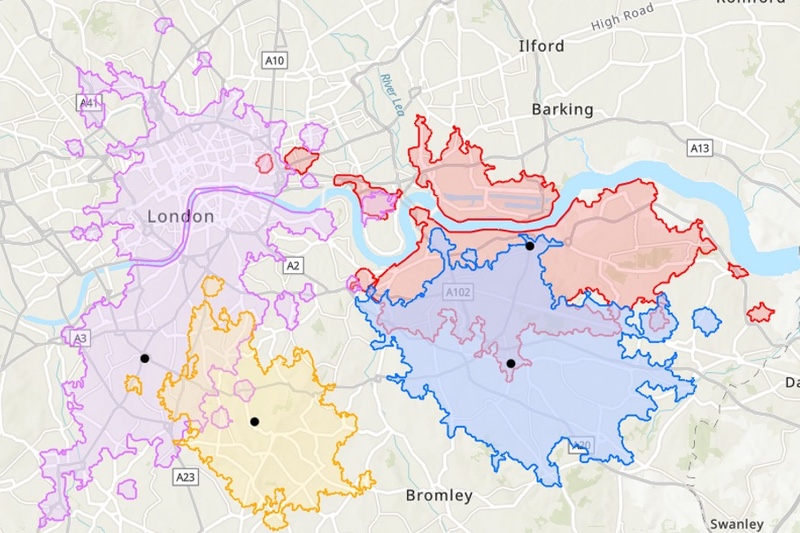
Journey time analysis was considered to identify which sites were the most accessible
The spatial analysis examined existing service usage in primary and secondary care for long-acting reversible contraceptives, heavy menstrual bleeding and menopause treatments over time. This was aggregated by LSOA to identify the areas of patient residence for those who have the most appointments and attendances for the above health needs. It was important to identify which potential hub sites were situated close to patients needing the most care.
Alongside the challenges that accompany learning to use a new software, there were considerations around how to use rich sources of data, that span multiple healthcare settings and are linked by a common pseudonymised NHS number. Initially, the team planned to map the data at a patient level to assess the service usage of residents from a particular area and how it differed based on demographic factors such as ethnicity, deprivation and age.
The data was sourced from both primary and secondary care and at a patient level there was an enormous amount of data from the past few years. NHS SEL aggregated the data by LSOA and type of activity (e.g. outpatient appointment for heavy menstrual bleeding) and chose to focus primarily on the relationship between service activity and deprivation.
Journey time analysis was considered to identify which sites were the most accessible. Analytical tools within the Esri software showed the area around each possible site that could be reached within 30 minutes of public transport, highlighting which of the potential sites were accessible via public transport for the largest amount of people in Southeast London.
The relationship between level of service usage and deprivation was analysed by LSOA. For Hormone Replacement Therapy (HRT) prescriptions, there was a negative correlation between the number of prescriptions and the level of deprivation – the greatest number of HRT prescriptions were for patients living in the least deprived LSOAs, based on the Index of Multiple Deprivation (IMD). This allowed stakeholders to consider locations for hubs that would provide accessible care for people living in the most deprived areas.


Jess Roe, Head of Analytics, Planning Directorate, NHS South East London, said: “Mapping service usage by LSOA across all boroughs revealed exactly where hubs would reach the most people and have the highest impact. Interactive map dashboards visualised the data, while apps with time sliders showed change over time, which helps predict future service demand.
“The visual impact of the analysis instantly convinced teams that the new Esri geospatial approach made sense. The location of the hubs is critical as they offer more specialist services than most GPs and give a single point of access to many different services. Geospatial analysis allows us to take a population health management approach to this.”
This is the first project where geospatial analysis was used as the main source of insights. As an analytics team, NHS SEL is very familiar with presenting data into dashboards containing tables and graphs, and this is what many of the stakeholders have come to expect from the team. Whilst keen to start using geospatial analysis, the team wanted a stakeholder who was equally as interested in exploring what GIS could do for their real use case.
Alice Gough, Programme Manager for Women’s and Girls’ Health Hubs at NHS South East London and King’s Health Partners, said: “Using Esri applications to visualise the burden of conditions like fibroids and endometriosis at a neighbourhood level has been invaluable. It highlights unmet need and helps us shape our community outreach programmes including women’s and girls’ health hub service design, around the communities that need it most.”
This project was invaluable not only because of the impact it had in highlighting which hub sites would best meet the demand for women’s health services in south east London but also because of the knowledge gained from utilising a new software to present the wealth of data. Working with Esri, NHS SEL learned different ways its data can be presented, utilising a variety of applications available, embedding dashboards and maps into a single presentation to build a story map for their stakeholders, sparking ideas for how spatial data analysis can be used in current and future reports across south east London.
The hope is for more insights to be generated using a geospatial approach in the future
NHS SEL is using the same approach to evaluate service usage over time to monitor any changes in how and where the public are engaging with women’s health services in collaboration with its programme manager, King’s Health Partners and the evaluation team. Results will help highlight particularly low or high uptake of services within communities and further address any inequality in service delivery. Future plans for the project include looking at what new data could be added to the analysis, such as cervical screening, referrals to secondary care gynaecology services and sexual health data.
NHS SEL’s Analytics team is excited to gain access to Acorn (A Classification Of Residential Neighbourhoods), which provides a geodemographic segmentation of the population, allowing the team to understand not only where demand for services, prevalence of conditions or the need for targeted intervention may be but also the households that make up those areas. This type of data will enhance the work the team already does as the ICB moves to a strategic commissioning organisation.
The opportunity for this piece of analysis was a result of the NHS SEL Analytics team showcasing the possibilities of GIS in solving real-world questions and highlighting the art of the possible. The hope is for more insights to be generated using a geospatial approach in the future, showing its value and generating more requests for this type of analysis in the future. The team plan to continue emphasising the benefits of using geospatial analysis, particularly to colleagues who may not realise it’s even a possibility!