

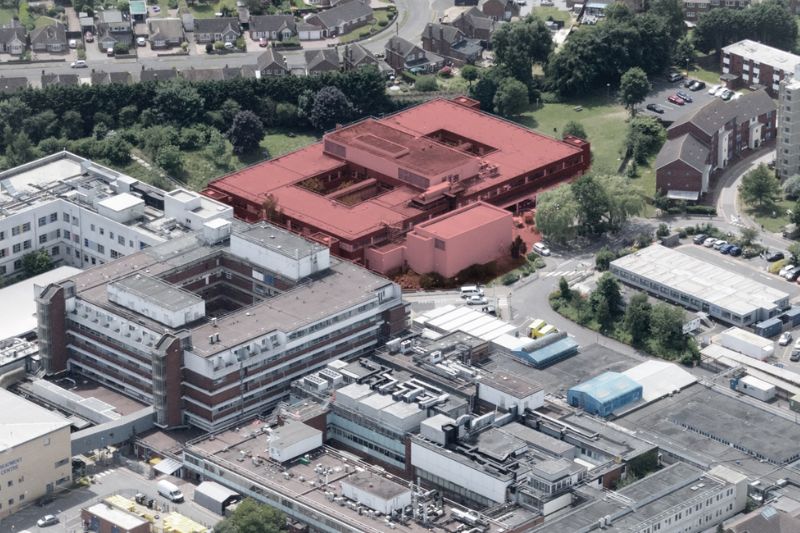
Medical Architecture has been appointed by Kettering General Hospital NHS Foundation Trust to produce an Outline Business Case for removing Reinforced Autoclaved Aerated Concrete (RAAC) from the Rockingham Wing, which houses the Trust’s maternity, gynaecology, and neonatal services.
RAAC, a lightweight concrete commonly used in hospitals built between the 1950s and 1980s, can fail suddenly as it ages, posing a critical safety risk.
Following its discovery in the Rockingham Wing roof in December 2023, temporary measures have been implemented to keep services operating safely while a long-term solution is developed.
Commenting on the problem of partial RAAC removal in a hospital estates, Mark Nugent, Associate Director at Medical Architecture, told Building Better Healthcare:
“Where only part of an NHS building contains RAAC, but other elements remain structurally sound, there is a clear temptation to replace only the affected components, such as the roof, as a pragmatic, cost-effective fix,” said Nugent.
"It is important to consider the long term value of this and assess all potential options.”
National push to replace ageing estates
Under the New Hospital Programme, the NHS has been taking steps to prioritise replacing RAAC from seven hospitals.
The removal of RAAC was originally scheduled to be completed by 2030, but the programme is now behind schedule, with replacements not expected until 2032–33.
The seven hospitals are: West Suffolk, Hinchingbrooke, James Paget, Queen Elizabeth (King’s Lynn), Leighton, Airedale, and Frimley Park.
Kettering General Hospital is not included in the 7 prioritised hospitals.
“The 7 hospitals have been prioritised because they were most affected by RAAC. KGH has confirmed RAAC on the Rockingham Wing building only,” representatives from the Kettering General Hospital NHS Foundation Trust told Building Better Healthcare.
How RAAC removal can improve sustainability
Nugent said that RAAC eradication projects provide an opportunity to not only address immediate safety risks but also deliver modern, energy-efficient facilities that meet Trust’s long-term clinical and sustainability needs.
“If you look collectively at upgrades to the thermal envelope, doors, windows, roof and services, alongside asbestos removal and temporary decant costs, overall expenditure can quickly escalate,” said Nugent.
“In considering the value of this, it is important to recognise that design guidance and space standards that informed many historic buildings are now obsolete. Existing layouts may struggle to accommodate modern clinical models and equipment, leading to sub-optimal healthcare environments. Where site capacity allows, a phased replacement of existing accommodation can provide better long-term value.”
Nugent said that the firm's approach can deliver a compliant, thermally efficient building aligned with NHS net zero ambitions and capable of reducing operational costs over time.
At Kettering General Hospital, Medical Architecture, acting as design lead, will work with a multi-disciplinary team including Strategic Healthcare Planning, WT Partnership, CPW, Couch Consulting Engineers, Lichfields and PJA to ensure all options are properly evaluated.


