

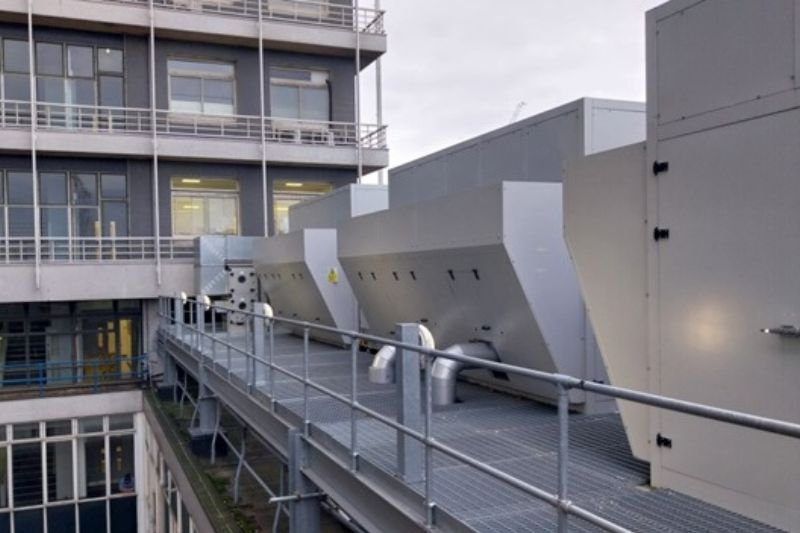
Imperial College Healthcare NHS Trust (ICHT) has committed £47.4m over the next two years to upgrade heating, ventilation and electrical systems across its estate.
It is one of the largest decarbonisation programmes currently underway in the NHS.
“Decarbonising our estate is a complex task, with many of our buildings rapidly ageing and reliant on outdated, inefficient gas boilers,” said Eric Munro, Director of Estates and Facilities at Imperial College Healthcare NHS Trust.
Under the programme, the Trust will replace gas-based infrastructure with low-carbon technologies including air-source heat pumps, upgraded air-handling units, improved insulation, modern energy-management controls and LED lighting.
Several sites will also receive new solar panels to support cleaner, more efficient energy generation.
Overall, the changes are expected to deliver a 43% reduction in emissions compared with 2020–21 levels.
The Trust is delivering the work alongside sustainability and estates teams and partners, including Dalkia and CBRE.
National net-zero context
The ICHT programme aligns with the wider NHS goal to achieve net-zero emissions by 2040.
To support decarbonisation across the public sector, the government launched the £1bn Public Sector Decarbonisation Scheme (PSDS) in 2020.
While no new funding rounds are currently planned, existing awards, including those allocated to ICHT, remain in place.
“The Government has recently said that it will not be committing further investment for the PSDS, but they have confirmed that all current awards including ours will remain fully funded,” said Munro.
Imperial’s updated Green Plan, submitted in July alongside plans from all Trusts and Integrated Care Boards, aligns with this national target.
Major upgrades across Imperial’s estate
Charing Cross Hospital has acted as the first major test site, installing large-capacity heat pumps and refurbishing plant rooms and air-handling systems.
These works have already cut building-related emissions by 27% in a single year, despite the challenges of construction in a live clinical environment.
Further heat pumps and expanded digital controls are planned.
At Hammersmith Hospital, the new funding package will deliver the site’s first solar panels, alongside new LED lighting, ventilation controls and energy-efficient electrical systems.
The Trust says these improvements will reduce carbon emissions and improve service resilience by replacing ageing systems that have become prone to failure.
Many of the Trust’s buildings are more than a century old, with some dating back 170 years.
While Charing Cross and Hammersmith will undergo major retrofits, sites such as St Mary’s Hospital, scheduled for full redevelopment later in the decade, will receive smaller-scale measures including LED upgrades and enhanced energy-management software.
This avoids major investment in infrastructure that will be replaced as part of the longer-term rebuild.
Other NHS efforts to cut carbon emissions
Elsewhere in the NHS, several Trusts have recently secured significant PSDS funding to support decarbonisation.
In May, Newham Hospital received £13.8m for rooftop solar panels, electric heat pumps, LED lighting and upgraded electrical infrastructure.
Pilgrim Hospital was awarded £23m to shift its heating and hot-water systems away from fossil fuels towards electric solutions.
At Chelsea and Westminster Hospital NHS Foundation Trust’s West Middlesex University Hospital, the new all-electric Ambulatory Diagnostic Centre is being fitted with fully electric air-handling units, replacing gas-fired coils and improving air quality.
Together, these builds signal a decisive shift across the NHS estate to move ageing hospitals toward low-carbon, electrically-powered facilities built for long-term resilience and a net-zero future.


