
Healthcare spaces are where we are often at our most vulnerable.
They are environments in which we seek comfort, safety and healing, and where design decisions can profoundly influence wellbeing.
For neurodivergent people, who may experience heightened sensitivity to colour, light, sound and spatial change, the physical environment is not simply important; it can be integral to recovery.
As the updated Mental Health Act 2025 reshapes expectations around patient-centred care, the connection between environment and outcomes will become increasingly difficult to ignore. Inclusive design is no longer a ‘nice to have’ — it is fundamental to building better healthcare.
Designing beyond one-size-fits-all
It is important to acknowledge that designing for neurodiversity is never a one-size-fits-all exercise.
Every neurodivergent person experiences the world differently, with unique sensory profiles and preferences. What soothes one individual may overstimulate another.
This makes early engagement with end users critical. Rather than relying on assumptions, designers and healthcare providers should seek direct input wherever possible. True inclusion starts with listening.
With around one in seven people in the UK estimated to be neurodivergent, healthcare environments must move beyond clinical functionality to create spaces that actively support diverse sensory needs.
Yet despite growing awareness, our Designing for Neurodiversity report found that 79% of architects and specifiers acknowledge a knowledge gap when it comes to designing for neurodivergent users, while 62% report that neurodiversity is appearing more prominently in project briefs than ever before.
This presents both a challenge and an opportunity: how do we bridge the gap between awareness and confident implementation, particularly in complex healthcare environments where the stakes are so high?
Learning from practice: Cygnet Health Care
Real-world projects provide valuable insight.
At Crown Paints, we have worked closely with Cygnet Health Care on a number of mental health facilities, including Cygnet Kenney House in Oldham, a dedicated hospital for women with mental health needs.
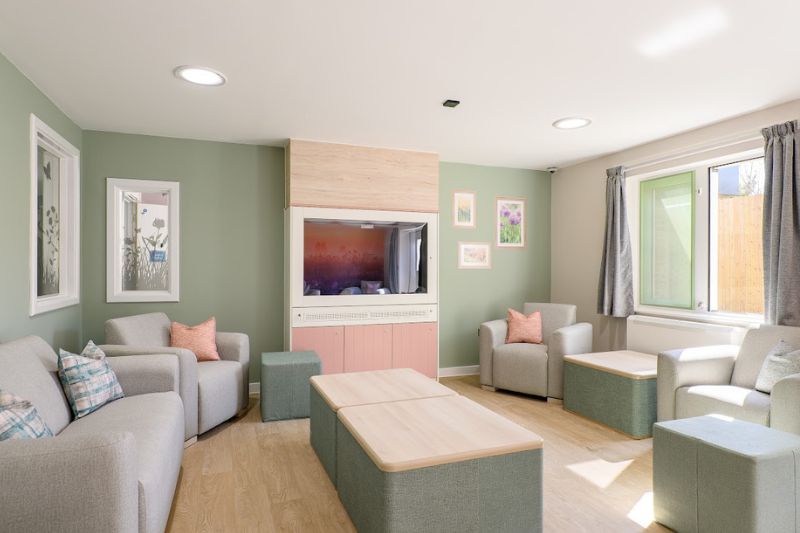
From the outset, the ambition was clear: create a space that feels like a home away from home rather than an institution.
Working alongside Cygnet’s interior fit-out lead, Hannah Cooper, we developed a considered colour strategy tailored to support both patients and staff.
The design began with a blank canvas and a commitment to intentional choices.
Instead of traditional brilliant white, often perceived as cold and clinical, a warmer neutral base was used throughout.
This subtle shift immediately softened the environment, helping patients feel more at ease on arrival.
Different areas were given distinct identities through thoughtful colour zoning.
Reception incorporated calming blue tones with soft green accents, reinforcing brand identity while creating a welcoming first impression.
The dining area was designed to echo the familiarity of a local café, supporting normality during mealtimes, an often overlooked but vital part of recovery.
Crucially, bedrooms were kept purposefully neutral. These spaces act as personal retreats, offering a calm backdrop that patients can personalise.
This avoids unnecessary overstimulation while supporting dignity and autonomy.
Durability and hygiene were addressed without compromising aesthetics.
High-performance finishes were specified to help defend against bacteria and mould, demonstrating that safety and warmth are not mutually exclusive.
Practical principles for inclusive healthcare design
Projects like this highlight several core principles for architects and specifiers seeking to build more inclusive healthcare environments:
1. Treat colour as a clinical tool
Low-intensity, muted tones can support calm and focus. Highly chromatic or stark white finishes may create visual stress for some individuals. However, colour is deeply personal, and choices should always be context-specific and informed by consultation.
2. Prioritise considered lighting
Many sensory-sensitive individuals have a low tolerance for harsh artificial lighting, particularly fluorescent sources. Maximising natural light, using diffused fittings to reduce glare, and incorporating dimmable controls can significantly improve comfort and give individuals a sense of control.
3. Address acoustics early
Excessive reverberation can make conversation and concentration difficult. Acoustic treatments, careful material selection and thoughtful spatial planning all contribute to environments that feel manageable rather than overwhelming.
4. Balance durability with dignity
Healthcare settings require robust, hygienic finishes. But performance does not have to come at the expense of warmth or visual appeal. High-specification materials can coexist with softer, more residential design cues.
5. Provide spatial variety
Recovery is not linear. Patients may require quiet, enclosed spaces at one moment and more open, social areas at another. Offering a range of environments, from low-stimulation retreat zones to communal spaces, supports autonomy and acknowledges fluctuating needs.
Making inclusion standard practice
Inclusive design should not be viewed as a specialist niche. It is simply good design, design that recognises how people truly experience spaces and responds accordingly.
As the Mental Health Act 2025 takes effect, healthcare providers will increasingly be expected to demonstrate their commitment to environments that respect individual needs and actively support recovery.
Legislative change brings both accountability and opportunity.
Building better healthcare means moving beyond assumptions, embedding consultation into the design process and creating environments that foster dignity, comfort and hope.
For neurodivergent patients, that means spaces that work with their sensory experiences rather than against them.
The question is no longer whether we should design inclusively, but how quickly we can make it the standard of care.


