
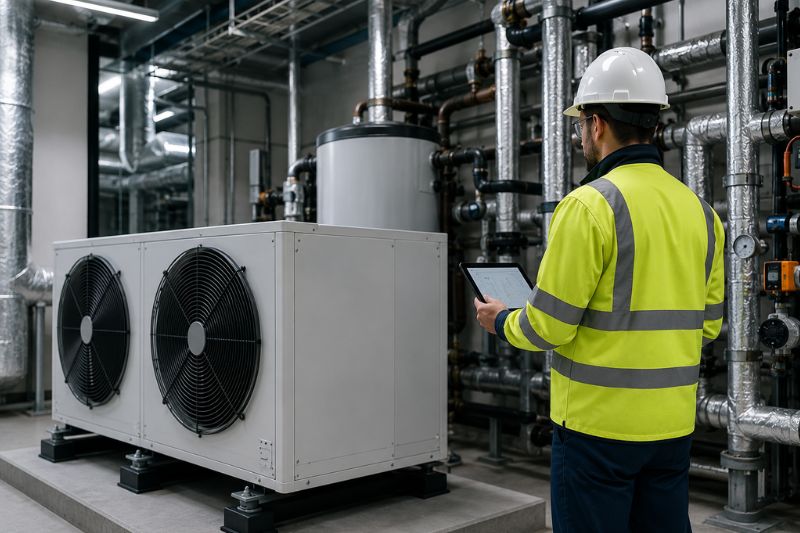
In its report to parliament in June 2025, the UK’s Climate Change Committee underscores how buildings and heating decarbonisation are crucial to meeting carbon budgets and net zero commitments.
It highlights the scale of transition required in the heat sector and the urgency for effective delivery, beyond just technology adoption.
For the healthcare estate, from acute hospitals to community clinics, this challenge is heightened by 24/7 operation, infection control requirements and strict comfort thresholds for vulnerable patients.
That transition, however, needs to lean on new ways of delivery, not just technology, says Harry Davis, founder and managing director at Eden Energy Partners.
Here, he argues that as the industry accelerates towards electric, heat pump-led buildings, many designs still rely on legacy assumptions about heat distribution.
In healthcare settings, those assumptions can have significant operational and financial consequences.
On paper, the journey towards net zero buildings looks clear. Across many sectors, gas boilers are being replaced with air and ground source heat pumps, electric networks are expanding, and policy is steadily tightening around operational carbon.
Within the NHS and wider private healthcare sector, decarbonisation strategies are now embedded in long-term estate plans, with many Trusts committing to ambitious net zero timelines.
But there still exists a growing disconnect between the heat sources we are specifying and the buildings we are designing to receive that heat.
If buildings are not designed from the outset to operate efficiently at lower flow temperatures, the performance gap is effectively designed in, regardless of how low-carbon the heat source may be. In hospitals, for instance, this can translate into higher running costs and increased strain on already stretched facilities teams.
Heat pumps are fundamentally different from the fossil fuel systems they replace. They work best when delivering heat at lower flow temperatures, typically in the 35–50°C range rather than the 70–80°C that traditional boiler-led systems operate at.


