

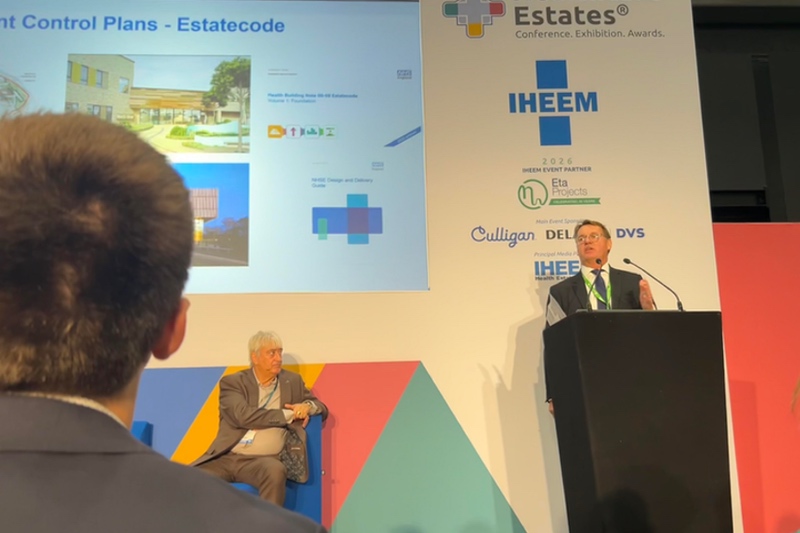
Healthcare Estates is an annual conference that gathers those working to build and maintain the physical healthcare infrastructure in the UK.
The two-day event features exhibitors from across the design and construction spheres. Speaking to the hosts, the event surpassed 2025 attendance on the first day, so the lanes were buzzing with attendee talks.
Within this same hall of over 250 exhibitors, there are a number of areas for talks. A fair few of the talks were given in the Keynote Theatre from NHS England (NHSE), with speakers giving critical updates on the progress of a number of national programmes, as well as revealing future aims.
A two-tier NHS?
Day 1’s keynote from NHSE addressed the conference theme of a “two-tier estate”. A two-tier estate would see an NHS estate split between new, digitally enabled, well-funded facilities in contrast to ageing, under-invested buildings that struggle to meet modern clinical and digital needs.
Across the two days, NHS England’s central message was that a two-tier estate is avoidable, because long-term capital is now secured within the 10-Year Plan.
Simon Corben, NHSE’s Director and Head of Profession, said “capital is up 100%”, with £119bn committed over the remaining nine years: “the most commitment we’ve ever had in the NHS”. Only about £24bn goes to new hospitals, so there is “a real opportunity for you to do progressive builds” elsewhere.
Corben emphasised that he wants to see every trust have a current development control plan. He wants plans that project investment needs ten years ahead.
The NHSE Director said that when he asked estates directors at recent regional events who had a current plan, so few did that he stopped asking. The forthcoming estates code will set out what NHSE expects.
Fiona Daly, National Deputy Director of Estates for NHS England, later repeated the call to “get back to the basics of development control planning”.
The NHP programme progress
With projects now starting to come to completion in the New Hospital Programme, such as the National Rehabilitation Centre, there was a lot of success to reflect on this year with the NHP.
NHSE outlined how the programme is evolving from a capital investment programme into a wider system enabler, with a focus on standardising delivery, improving collaboration and building lasting capability across the NHS.
A key development in this is the establishment of the NHP Alliance. The Alliance bringing together NHS England, trusts and industry partners through a common framework. The alliance aims to improve coordination, share lessons between projects and support more consistent, repeatable designs through the Hospital 2.0 approach.
Wave One schemes are now helping to establish and test this delivery model, with learning already informing Wave Two projects.
North Manchester General Hospital was highlighted as an example of how national standards and construction expertise can be combined with local clinical and operational knowledge. Claire Wilson spoke to this scheme, as Chief Financial Officer of Manchester University NHS Foundation Trust and Senior Responsible Officer for the New Hospital Programme at North Manchester General Hospital.
The Alliance is also prioritising digital integration, modern methods of construction and early consideration of how hospitals will operate and be maintained.
In the Q&A session, an audience member asked a questions about if the NHS’s “left shift” could change what gets built. They asked whether moving care from hospitals into community settings would affect new-hospital designs. The response from NHSE was that Wave Two and Three schemes are now considering the implications for their scope, so they can accommodate the ambition to move more care closer to home.
That’s a potentially significant change to the programme’s requirements, although no specific reductions or redesigns were announced.
NHSE speakers stressed that the Alliance’s success will depend on identifying risks early, addressing supply-chain and workforce constraints, and applying lessons across the programme to improve outcomes for patients, staff and communities.
The Neighbourhood Health Centre programme progress
The topic of the Neighbourhood Health Centre programme also dominated over the two days, with an exciting blueprint launch by Wates and NHSE.
The new blueprint sets out a practical roadmap for delivering 250 neighbourhood health centres across England. It highlights the importance of long-term public-private partnerships, early contractor involvement and a coordinated project pipeline to accelerate delivery, attract investment and create modern, sustainable healthcare facilities.
On day 2, Matt Ward, Associate Director of National Estates Strategy and Planning, said the programme began with “about 1,100 potential opportunities”, now whittled to roughly 150, to be delivered in waves of 40–50 schemes over three years.
The outcomes of wave one will be reviewed imminently, and Ward hopes to make further announcements over the coming months on schemes for 2027/28 and a second wave. The government target is 250 centres, but Ward and his team think they “can get to more than 250 a lot quicker”.
We think we can get to more than 250 a lot quicker
Corben said NHSE hopes to take a PPP (Public-Private Partnership) programme for just under 250 units to market in the new year, with landlords offering space on “phenomenally competitive terms”.
Ward added that centres must be low carbon, flexible and digitally enabled: “it isn’t just about the buildings”.
New AI tool on the digital side of the NHS estate
The updates to digital tools were showcased in detail.
Part of the 10-Year Plan aims to see the NHS move from analogue to digital. In terms of where the estate is in 2026, Daly reported an average digital maturity score of 2.5 out of five across 147 trusts.
Daly said that although 2.5 might sound poor, “it’s not”. She explained that “not even the big massive tech firms are at five”, so the NHS isn’t doing badly.
Daly did add that the estates teams' average was slightly behind the clinical teams’ in this regard.
In other recent news, Corben revealed that a new AI agent has been added to the digital and planning tool Strata over the last six months. Strata is a governmental platform which holds details on every NHS asset for oversight and planning purposes.
In a demonstration, Corben loaded the neighbourhood health centre specification for one ICB and asked which buildings could be considered neighbourhood health centres. Within minutes, the AI agent identified candidates, the services needed to make them full centres, a building left vacant as a result, and its housing and land-value potential. He called it “unbelievably impressive”.
Another way digital tools are aiming to help is with regard to the workforce. 41% of NHS estates staff are likely to retire within a decade, and NHSE sees digitalising assets as one way to bridge part of that gap.
Separately, in another angle to address the workforce, a new engineering graduate stream will take 25 graduates this year, rising to 50 a year from next year.
Practical steps to address the maintenance backlog
From a maintenance point of view, guidance is imminent.
NHSE explained that the estates code is “on the cusp” of publication and the estates blueprint is awaiting board approval. NHSE hopes to deliver a capital design guide within six months.
NHSE also hopes to take a national asset survey to market in the new year to “recalibrate backlog maintenance”, with surveys starting in 2027/28.
To make their case for funding, NHSE wants evidence for the Treasury. Corben said “several hundred” infrastructure failures happen daily, yet he “could count on one hand” those logged over summer.
Daly urged staff to move away from “this kind of hide it culture"
A new QR-code tool has now been launched to help trusts report and quantify disruption costs. Daly urged staff to move away from “this kind of hide it culture”.
National commitments of the future
Ultimately, Healthcare Estates 2026 offered a clear message: the NHS estate is entering a period of significant opportunity, but turning investment into meaningful change will depend on effective planning, stronger partnerships and better use of data.
The challenge now is to translate these national commitments into tangible improvements for NHS staff, patients and the buildings they rely on.


