

Five research and partnership hubs are to receive more than £52m in government funding to develop healthcare technologies aimed at detecting diseases earlier and supporting patients to manage their health in the community.
The investment, provided through UK Research and Innovation (UKRI), will support projects spanning brain health, cardiovascular disease, diabetes, traumatic brain injury and respiratory infections.
The hubs will bring together universities, NHS organisations, charities and industry partners to develop technologies that could help identify health risks before symptoms develop, improve diagnosis and reduce demand on hospital services.
The programme will also receive a further £37.5m in cash and in-kind contributions from project partners, including Google, Siemens and Medtronic.
AI to support earlier diagnosis of dementia
One of the projects, the AI and Emerging Technologies for Next Generation Brain Health Clinics (BRAINIAC) hub, will establish the UK's first network of NHS brain health clinics.
Led by Professor David Llewellyn at the University of Exeter, the project will bring together blood tests, brain scans and digital memory assessments using artificial intelligence (AI) to provide a more comprehensive picture of a person's brain health.
Ten sites across the UK will test the technology with more than 1,700 patients, with the aim of making it suitable for wider NHS use.
The project will involve Dementia UK, Alzheimer's Society and the National Institute for Health and Care Research (NIHR) HealthTech Research Centre.
UKRI said the technology aims to help reduce dementia risk and accelerate diagnosis by up to 50%, enabling patients to access support earlier.
Technology to assess traumatic brain injuries
The Brain Research for Adaptive Traumatic Injury: Simulation, Assessment, Forecasting and Education (BRAIN-SAFE) hub will develop computer models to assess the risks associated with head injuries.
Led by Professor David Sharp at Imperial College London, the project will bring together engineers, AI specialists and clinicians to develop tools that predict an individual's risk of brain injury following an impact.
The models will consider factors including age, sex and previous injuries.
The technology is intended to support real-time assessments of head injuries in sport and road traffic accidents, with potential applications including pitch-side alerts, smartphone and vehicle crash data, and improvements to helmet and vehicle safety.
Project partners include the Rugby Football Union, Premiership Rugby, Premiership Women's Rugby, World Rugby, Rugby Football League, The Football Association, Premier League, GB Boxing, Institute of Sport, Exercise and Health, British Equestrian Trades Association and Sports & Wellbeing Analytics Limited.
Other partners include Jaguar Land Rover, Autoliv, Euro NCAP, the Parliamentary Advisory Council for Transport Safety (PACTS), the Impact Centre for Post-Collision Research, Innovation and Translation, Royal Air Force, Defence Medical Services, Ansys, George Institute for Global Health, Headway, Nvidia, Monash University and Stanford University.
AI to identify cardiovascular disease and diabetes
At King's College London, the EPSRC HeartTech Hub will develop technologies to support personalised cardiovascular care and help patients manage their heart health outside hospital.
Led by Professor Sebastien Ourselin, the hub will combine data from wearable devices, advanced imaging and health records to identify people at risk of cardiovascular disease earlier.
It will also develop an AI-powered wellbeing coach to provide personalised guidance on lifestyle changes and alert users when they should seek advice from a healthcare professional.
Partners include Siemens Healthineers, GE HealthCare, Google Health UK, Garmin, Canon, Heartfelt Technologies Ltd, Cardiology Devices Ltd and Medtronic.
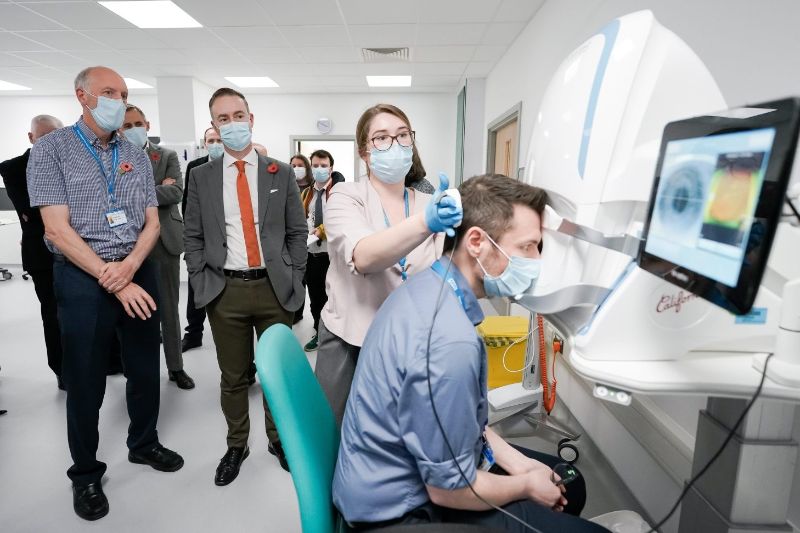
Meanwhile, the Northern Ophthalmic Research and Innovation (NORI) hub, led by Professor Matthew Campbell at the University of Sunderland, will use AI to identify early signs of diabetes and cardiovascular disease through routine eye scans.
The technology will analyse images of the retina alongside NHS health records and community data to identify subtle changes in blood vessels and nerve tissue that could indicate underlying health conditions.
The project will initially focus on diabetes and cardiovascular disease, with the potential to expand its application to conditions including stroke and dementia.
Partners include South Tyneside and Sunderland NHS Foundation Trust, Sunderland City Council, Moorfields Eye Hospital and Topcon Healthcare.
Smartphone technology to monitor respiratory infections
The fifth project, the Community Respiratory Infection Screening and Prognostics (CRISP) Hub, will develop technologies to help patients and healthcare professionals assess respiratory infections.
Led by Associate Professor Alexander Edwards at the University of Southampton, the hub will develop wearable sensors, smartphone applications that analyse coughs and breathing, and rapid tests for use in homes and community healthcare settings.
AI will combine information from these technologies to predict how an infection is likely to develop and help determine whether a patient can recover at home or should seek medical advice.
The technology is intended to provide patients with personalised guidance on whether to rest or contact a pharmacist or GP, while supporting healthcare professionals in making treatment decisions.
Partners include Nokia, Samsung, the Department of Health and Social Care, South Central Ambulance Service and Community Pharmacy Hampshire.
Supporting healthcare innovation
The five hubs are based in Exeter, London, Southampton and Sunderland and will work with patients, healthcare professionals and industry partners to develop and test their technologies.
The funding builds on previous UKRI-supported research hubs, which have contributed to developments including the world's first AI-assisted brain tumour surgery.
Professor Charlotte Deane, Executive Chair of the Engineering and Physical Sciences Research Council (EPSRC), said the new hubs would help translate engineering and physical sciences research into technologies with practical applications in healthcare.
She added that working with patients, the NHS and industry would help support earlier intervention and the prevention of ill health.
The investment includes a £1m contribution from the UKRI Life Sciences Programme towards the HeartTech Hub.


