


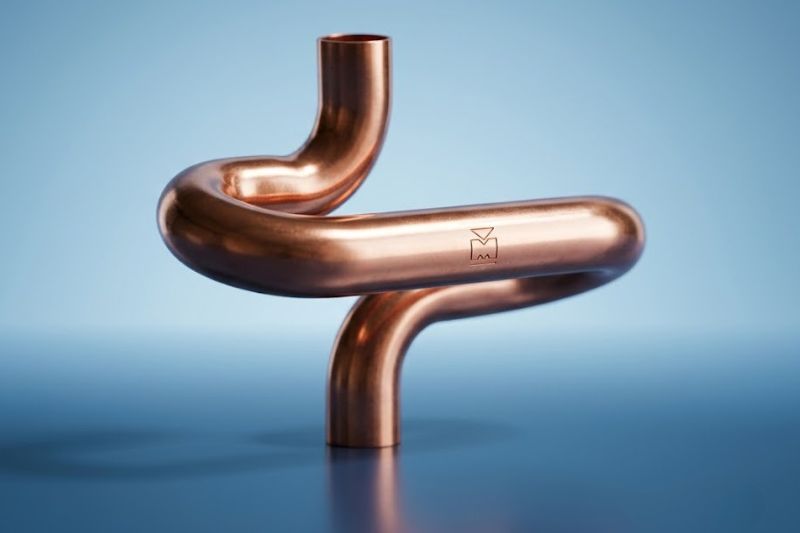
Mueller Europe has launched AseptiFlow, a mechanical device made from high-grade copper tubing that is designed to reduce the transmission risk of Gram-negative waterborne pathogens from hospital sinks and drains.
The company manufactures and distributes copper tube for plumbing, heating and industrial applications, as well as air-conditioning and refrigeration systems.
“AseptiFlow has been incredibly well received throughout the NHS and we have installations spanning England, Scotland and Northern Ireland already,” Paul Owen, Global Business Unit Manager for Healthcare & Life Sciences at Mueller Europe, told Building Better Healthcare.
Owen said AseptiFlow has been designed for both new-build and retrofit projects, with installation taking less than eight minutes per unit.
Developed by Consultant Microbiologist Dr James Soothill at Great Ormond Street Hospital (GOSH), the device has been brought to market by Mueller Europe, which has established a dedicated Healthcare & Life Sciences division to commercialise the technology.
AseptiFlow sits beneath the sink outlet and above the U-bend, physically interrupting the pathway through which potentially contaminated water droplets can travel back up through the plughole into the sink bowl.
The device is made from high-grade copper, which Mueller Europe says also provides inherent antimicrobial properties.
The product was developed by Soothill with David Chapman-Jones, GOSH’s Research and Innovation Business Development Head, and health technology consultancy Health Tech Enterprise.
Designing out infection risks
The technology is aimed at one element of the wider challenge of antimicrobial resistance (AMR).
AMR occurs when microorganisms such as bacteria, viruses and fungi no longer respond effectively to antimicrobial medicines, making infections harder to treat and increasing the risk of severe illness and death.
The World Health Organization identifies infection prevention and control as an important part of tackling the spread of antimicrobial resistance.
AseptiFlow specifically targets a potential transmission pathway associated with Gram-negative bacteria in sink and drainage systems.
Gram-negative bacteria include organisms such as E. coli and Pseudomonas aeruginosa, while drug-resistant Gram-negative bacteria are among the pathogens of growing concern to global health systems.
AseptiFlow is one cog in a much larger and ongoing Global project to prevent or reduce Antimicrobial resistance, said Owen.
Owen said AseptiFlow greatly reduces the transmission risks associated with Gram-negative bacteria, which are widely recognised as being some of the hardest bacteria to treat and traditionally require the use of carbapenems.
The WHO says drug-resistant Gram-negative bacteria are becoming more dangerous globally, with E. coli and Klebsiella pneumoniae among the leading drug-resistant Gram-negative bacteria found in bloodstream infections.
New-build and retrofit applications
Mueller Europe said AseptiFlow can be incorporated into new healthcare construction programmes or retrofitted into existing facilities.
“Our strategy for the next few years was a gradual launch across multiple territories with the priority being the UK,” Owen said.
The company said the copper device is infinitely recyclable.
The product is now being positioned as part of an approach to incorporating infection-risk considerations into the design of healthcare environments.
Patient and people safety must be engineered into the built environment, not managed after failure.
“The cost of doing nothing, with an acknowledged infection risk site, far outweighs the cost of doing something now,” Owen said.


