
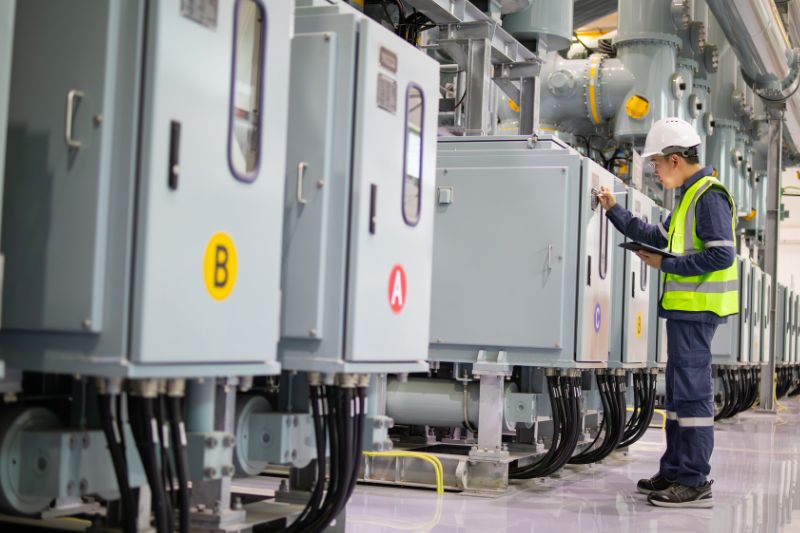
Hospitals are among the most complex buildings in the country. They operate 24 hours a day, support life-critical activity, and rely on infrastructure that must perform reliably under constant pressure.
Yet across much of the healthcare estate, facilities management strategies remain rooted in reactive fixes and asset replacement after failure, rather than proactive, insight-led management.
As a result, budgets are often consumed by emergency interventions instead of planned improvement, pulling estates teams into a constant firefighting mode. Over time, resilience erodes, driven by limited visibility into how infrastructure is actually performing.
Digital technologies are beginning to shift this dynamic. By providing the clarity needed to anticipate rather than react, they are enabling facilities teams to take a more strategic role in managing critical infrastructure.
Seeing infrastructure before it fails
The foundation of modern healthcare maintenance is visibility. When estates teams can understand how assets are behaving in real time, maintenance is no longer driven by guesswork or periodic inspection.
Connected sensors and monitoring technologies now allow critical systems to be continuously observed, tracking performance indicators such as temperature, load, vibration and power quality. Instead of discovering problems only after disruption occurs, teams can identify early signs of deterioration.
This shift is subtle but significant. Continuous awareness replaces periodic checks, and insight replaces assumption, moving maintenance away from detecting failure to preventing it.
As performance data builds over time, analytics and diagnostic tools add further depth. Patterns and anomalies begin to emerge that would otherwise remain invisible. Deviations from normal behaviour can be identified early, highlighting inefficiencies and signalling where failure is likely if no action is taken.
For healthcare estates, this predictive capability is critical. It protects uptime while ensuring limited resources are directed where they will have the greatest operational impact.
Turning insight into operational control
Healthcare infrastructure does not operate in isolation. Electrical systems, HVAC, medical gases and energy networks are deeply interconnected, yet they have traditionally been managed in silos.
Digital platforms are increasingly bringing these systems together, creating a single, coherent operational view that reflects how hospitals actually function day to day.
With this integrated oversight, decision-making becomes clearer. Estates teams can identify which assets are most critical, what intervention is genuinely urgent and what can safely be deferred. In high-pressure environments, this level of clarity is essential.
There is also a growing role for remote monitoring and service models. Specialist engineers can oversee infrastructure performance continuously, supporting on-site teams with insight, diagnosis and guidance as issues emerge.
In this model, digital systems provide early warning, while human expertise determines the right response. Together, they transform maintenance from a reactive, site-based function into a managed, strategic capability.
Resilience is no longer dependent solely on emergency response, but on foresight and disciplined operational control.
Redefining maintenance in the healthcare estate
Digital technologies are doing more than modernising infrastructure — they are reshaping how healthcare organisations think about risk, reliability and responsibility.
Resilient hospitals are not created through new assets alone, or through response plans. They are sustained through visibility, foresight and disciplined maintenance, supported by systems that turn complexity into clarity and enable better decision-making.
In a healthcare system under sustained pressure, one of the most valuable transformations may also be the least visible: infrastructure that simply works, quietly and reliably, day after day.