
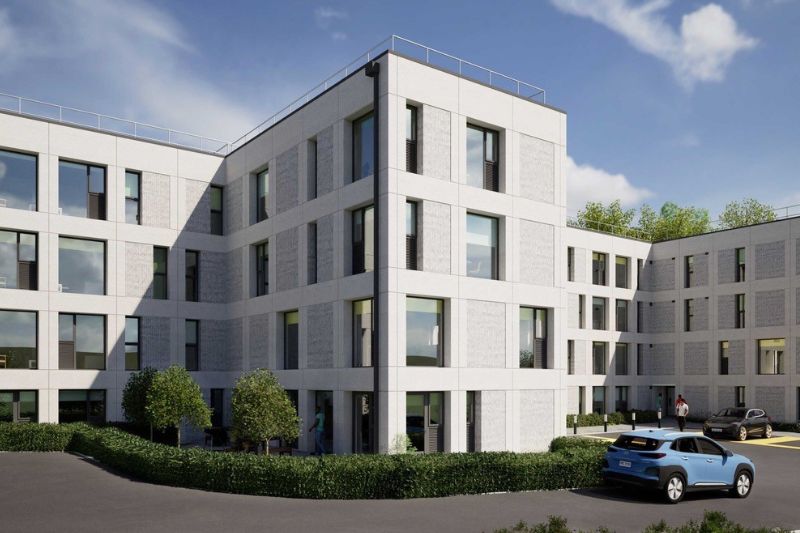
Aimed at strengthening recruitment in one of England’s most remote settings, BAM has begun construction of a 120-bed staff accommodation scheme at North Devon District Hospital.
“[The Trust] recognised that investment would be needed for the new hospital development,” Tim Chell, Health Lead at BAM, told Building Better Healthcare. “As such, they're ensuring that their accommodation meets current sustainability standards to attract staff to work in that area.”
Procured via the Southern Construction Framework, run by Devon County Council, the development forms part of the hospital’s wider estate strategy to modernise facilities and aligns with its long-term ambitions under the New Hospital Programme.
Completion is scheduled for September 2027, positioning the new accommodation to support future phases of development at the site.
A build to aid recruitment
Rather than responding to retention challenges, the scheme will support recruitment, particularly for staff relocating to the area.
By offering modern, en-suite accommodation close to the hospital, the trust aims to reduce barriers for clinicians and healthcare workers considering roles in North Devon.
The residence will comprise approximately 120 units, including accessible accommodation that’s designed to a consistent modern standard.
How will the build be sustainable?
BAM has completed its RIBA Stage 3 carbon assessment, achieving 762kg CO₂ per square metre, a figure Chell describes as a strong result for a healthcare project.
The building is targeting an EPC A rating and BREEAM Excellent certification.
“There’s a clear push within the health sector towards sustainability,” Chell said. “We’re seeing that across our projects nationwide and this scheme reflects that direction of travel.”
BAM, which has delivered £420m of healthcare facilities during the past five years and is currently on site with 15 major healthcare schemes across the UK, says decarbonisation is a central driver for its health portfolio.
The challenges of doing a build in a rural location
To address the logistical challenges of building in a rural location, the project will incorporate off-site manufacturing.
A prefabricated concrete frame solution will be used, manufactured off site and assembled on location to reduce both labour requirements and programme risk.
The approach, developed collaboratively between BAM, the design team and the Trust, is intended to de-risk delivery and maintain programme certainty.
The contractor undertook a detailed pre-construction period to refine the business case and coordinate design before starting on-site.
BAM’s emphasis on social value
BAM states that 80% of the project spend will be sourced locally, underpinned by detailed supply chain mapping to provide transparency and accountability.
Chell observed that social value within construction has evolved markedly during the past two decades, shifting from a peripheral consideration to a measurable and auditable element of project delivery.
Reflecting this approach across its wider operations, BAM reports generating approximately £400m in social value each year.
On the nearby Appledore Clean Maritime Innovation Centre, which BAM is building for Torridge District Council, BAM’s site team has already contributed £4000 to local charitable initiatives, demonstrating how this broader commitment is being applied on the ground.
"Social value is about more than building,” Chell said. “It’s about what you leave behind in the communities where you work, from employing local labour to supporting schools and local organisations.
The contractor has an established presence in the region, having delivered multiple education projects nearby, which it says supports continuity in local supply chains and workforce engagement.
Learning from the collaboration with the Eden Project
BAM’s approach to healthcare environments is also being shaped by its collaboration with the Eden Project, first reported by Building Better Healthcare in its exclusive coverage of the partnership.
The collaboration draws on the Eden Project’s expertise in biodiversity, therapeutic landscapes and restorative green space design, with the aim of integrating healing gardens and biodiversity net gain principles into healthcare settings.
Chell described how his own perspective on therapeutic environments shifted as a result of the collaboration, following involvement in the creation of a sensory garden designed for blind users.
“The garden incorporated water features for sound and aromatic planting for sensory engagement,” said Chell.
He pointed to examples such as the garden spaces at Salisbury NHS Foundation Trust, where outdoor environments support patient recuperation, as illustrations of how landscape can play a clinical as well as environmental role.
The Eden partnership is already being piloted at Royal Liverpool University Hospital, with ambitions to embed biodiversity, therapeutic design and measurable environmental gain more widely across BAM’s healthcare projects.
For rural sites such as North Devon, biodiversity net gain requirements also present an opportunity to enhance natural surroundings while delivering essential infrastructure.
What is next for North Devon District Hospital?
While the staff accommodation project sits outside the core new hospital build, it is intrinsically linked to the site’s future.
"The New Hospital Programme is important,” Chell said, “but there’s also a huge amount of work across existing estates. Not every trust is getting a brand-new hospital, and there’s a responsibility to build sustainability and resilience into extensions and supporting infrastructure as well.”
By delivering accommodation ahead of major redevelopment phases, North Devon District Hospital is laying practical groundwork for expansion, ensuring that when new clinical facilities come forward, the workforce infrastructure to support them is already in place.
With completion targeted for 2027, the project represents an early but critical piece of the Trust’s long-term transformation: one that places recruitment, sustainability and community value at its core.


