
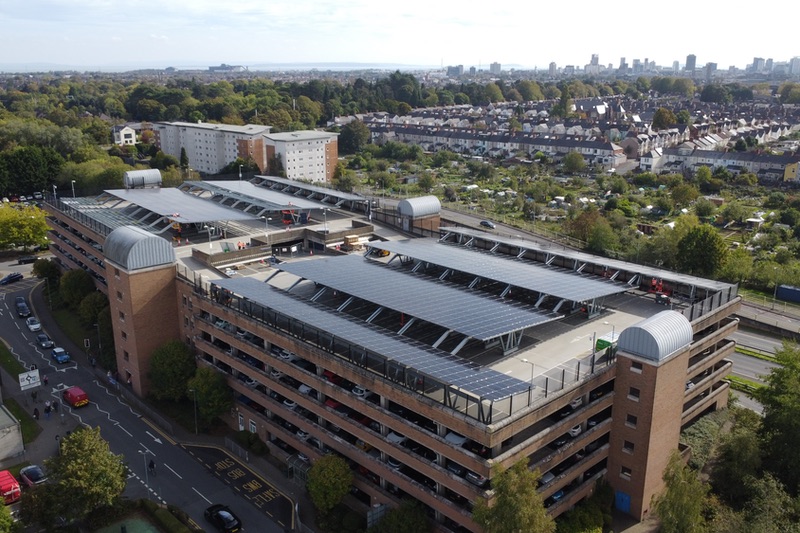
A major new solar carport installation at University Hospital Wales is demonstrating how renewable energy systems can be deployed safely within some of the most operationally sensitive healthcare sites in the country. Completed by RenEnergy UK, the project shows what can be achieved when renewable infrastructure is integrated into large acute hospital estates without interfering with emergency services or patient access.
Constructed on top of a live multi-storey car park, the system sits directly beneath the operational flight path of the hospital’s air ambulance helipad and immediately adjacent to a blue light emergency access lane. Both assets remained fully active throughout the construction period. The delivery team, therefore, had to work within stringent safety conditions while ensuring that the hospital’s clinical services, emergency operations and visitor routes continued uninterrupted.
Working within a live acute hospital setting
Unlike typical commercial or industrial solar installations, this scheme required an approach that placed clinical continuity at the centre of every decision. Construction logistics were shaped around patient flow, emergency response requirements and the need to keep all critical infrastructure fully accessible. To achieve this, work sequences were carefully planned, with out of hours activity used where necessary to reduce disruption and maintain safe movement around the site.
The installation was delivered in a uniquely constrained part of the estate, positioned directly beneath the active flight path of the hospital’s air ambulance helipad and alongside a blue light emergency access lane. Both areas had to remain fully operational throughout the programme. To accommodate this, RenEnergy planned construction activities carefully, coordinated continuously with hospital teams, and used phased and out of hours working where necessary. This ensured safe access for clinical teams, emergency vehicles, staff and visitors, and allowed the project to progress without any disruption to critical hospital operations.
Technical capacity and performance
The array is expected to generate enough electricity to supply approximately 200 typical UK homes over the course of a year. The system’s contribution to carbon reduction is also significant, with an estimated saving of around 102 tonnes of carbon dioxide emissions each year. This is comparable to


