
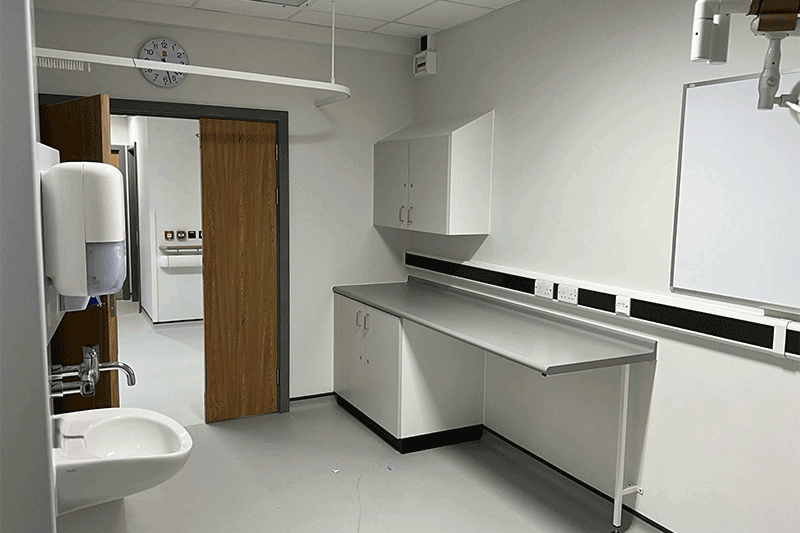
When people think about healthcare environments, they often focus on clinical expertise, medical equipment and operational efficiency. Yet for patients and residents, experience is shaped just as powerfully by the physical surroundings. The room they wake up in. The surfaces they touch. Even the storage areas that hold their personal belongings dictate the sense of privacy, or exposure, they feel each day, writes Katie Thompson, business development manager at David Bailey Furniture Systems.
Fitted furniture also plays a quiet, but influential, role in that experience. It can either reinforce the institutional nature of a setting or help create spaces that feel calm, respectful and human. In environments where individuals may already feel vulnerable, that distinction matters.
Healthcare design has evolved significantly over the past decade. There is greater recognition that the built environment contributes directly to wellbeing. Light, acoustics, layout and materiality all influence recovery, stress levels and overall emotional comfort.
Fitted furniture sits within these elements. Unlike loose items, it defines how a room functions. It determines where belongings are stored, how staff interact with the space and how easily it can be cleaned and maintained. When thoughtfully designed, it becomes part of the therapeutic framework rather than simply a functional addition.
Privacy is more than a curtain
Privacy in healthcare is often discussed in terms of consultation rooms and screening, but dignity extends beyond those moments. It includes how personal possessions are stored, whether clothing is visible to others and whether patients have a defined personal zone within shared accommodation.
Integrated wardrobes, discreet bedside storage and carefully positioned shelving can help establish boundaries without erecting barriers. Concealed service panels and coordinated finishes reduce visual clutter, allowing the room to feel less like a treatment space and more like a place of rest.
In mental health settings in particular, furniture design must balance robustness with sensitivity. Oversimplified or overly institutional forms can feel austere. Conversely, overly domestic solutions may not meet safety requirements. The challenge lies in creating fitted elements that feel calm and considered while meeting stringent compliance standards.
Storage as a source of calm
Clutter increases stress. Numerous studies in environmental psychology have linked disorganised surroundings with heightened anxiety. In healthcare, where individuals may already be experiencing uncertainty, clear and intuitive storage can make a meaningful difference.
Fitted furniture offers the opportunity to integrate storage seamlessly into the architecture of a room. Built-in cabinetry that aligns with wall planes, recessed shelving and flush doors contribute to visual order. When personal belongings have a designated place, patients retain a sense of ownership over their immediate environment.
For staff, well-planned storage improves workflow. Equipment is accessible yet unobtrusive. Supplies are organised logically. The space feels purposeful rather than reactive. This operational clarity indirectly benefits patients by reducing disruption and enhancing efficiency.
Material selection also carries emotional weight. Cold, highly reflective surfaces may communicate sterility, but can also feel unwelcoming. Conversely, warm textures and natural tones can soften perception without compromising hygiene.
Healthcare furniture must, of course, meet demanding durability and infection control requirements. Surfaces need to withstand rigorous cleaning regimes. Edges must resist impact. Joints must minimise dirt traps. Yet compliance does not preclude comfort.
Contemporary manufacturing techniques allow for finishes that are both resilient and visually reassuring. Wood-effect laminates, muted colour palettes and tactile surfaces can be specified within strict technical parameters. The result is an environment that feels composed rather than clinical.
The key lies in integration. When furniture, wall finishes and flooring are coordinated from the outset, the space reads as intentional. That coherence supports a sense of stability, an important psychological anchor for patients navigating unfamiliar circumstances.
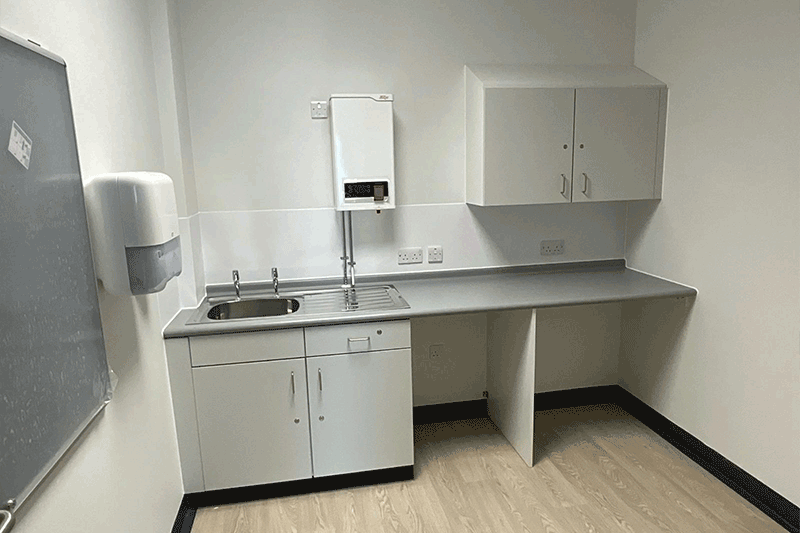
Layout and emotional comfort
Equally important, the placement of fitted elements shapes how a room is experienced. A cupboard positioned to create a subtle threshold can define personal territory. A unit integrated beneath a window can encourage natural light and orientation. Headwall units designed with simplicity can also reduce the visual dominance of medical services.
In dementia care environments, orientation and legibility are critical. Contrasting finishes can help residents identify storage areas. Rounded edges reduce injury risk while contributing to softer aesthetics. Familiar forms can provide reassurance.
Design decisions at this level may appear modest in isolation. Collectively, however, they shape emotional response. A space that feels logical and intuitive reduces cognitive load. A space that feels balanced reduces agitation.
We must also remember that dignity in healthcare extends to those delivering care. Staff operate in high-pressure environments where efficiency and clarity are essential. Fitted furniture that anticipates practical needs, such as integrated worktops, accessible storage and durable surfaces, enables smoother operation.
When staff can rely on their physical environment, interactions with patients become more focused and attentive. The absence of unnecessary friction contributes to a calmer atmosphere overall.
In refurbishment projects, this becomes particularly significant. Healthcare facilities often remain operational during upgrades. Precision-manufactured fitted furniture can reduce installation time and on-site disruption, maintaining continuity of care.
The importance of early collaboration
However, designing for dignity is rarely achieved through product selection alone. It requires early dialogue between architects, healthcare providers and specialist manufacturers like David Bailey Furniture Systems. Understanding patient demographics, clinical pathways and operational requirements informs the specification process.
At David Bailey Furniture, involvement at concept stage often reveals opportunities to refine layouts, simplify detailing and align materials with compliance objectives. The outcome is not a catalogue solution, but a coordinated response tailored to the environment.
This collaborative approach ensures that fitted furniture supports both regulatory demands and human considerations. It allows technical performance and emotional intelligence to coexist.
We can see, therefore, that it would be easy to regard fitted furniture purely as a practical necessity, a series of cupboards, panels and worktops fulfilling operational requirements. Yet in healthcare settings, these elements become part of the daily lived experience of patients and residents.
A thoughtfully integrated unit can preserve modesty. A calm material palette can reduce stress. Seamless storage can create order where uncertainty prevails. These are not superficial contributions. They are subtle reinforcements of dignity.
As healthcare design continues to evolve, the conversation is shifting from compliance alone to experience as well. The environments we create influence recovery, morale and perception. Fitted furniture, when approached with care and insight, becomes a quiet advocate for respect.
Designing for dignity is not an abstract aspiration. It is a series of deliberate choices about layout, materials, integration and collaboration. In the right hands, those choices help transform clinical spaces into environments that support wellbeing in its fullest sense.
For further information, visit: David Bailey Furniture Systems


