

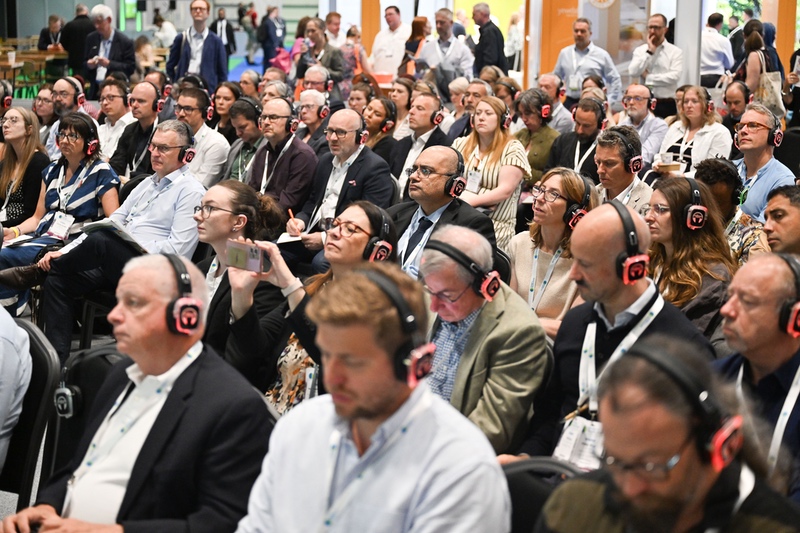
Design in Mental Health is an annual exhibition and conference hosted over two days in Coventry that provides a resource for those working in the creation of metal healthcare spaces.
Attendees at the conference consisted of a broad range of healthcare professionals and experts from around the world, spanning the public and private sectors and specialist charities, as well as providers for the built environment.
This year, the keynote talk was given by Prathiba Chitsabesan, the National Clinical Director for Children and Young People’s Mental Health, and Chair of the Clinical Reference Group.
Chitsabesan gave a big picture overview of the national landscape of young people’s mental health and facilities. She gave the overwhelming statistic that referrals to CAMHS have increased 57% since 2019. Child and Adolescent Mental Health Services (CAMHS) are NHS teams that assess and treat children and young people (up to age 18) struggling with severe emotional, behavioral, or mental health difficulties. If CAMHS facilities are not functioning well, this 57% is an added pressure.
The Director spoke a bit about how the needs of young people are changing, how the facilities and service avenues need to change to accommodate this. A facet of this that many may not have considered is the obesity issue in long stay inpatient facilities. “Facilities are not built for [long stays], so they often don’t even have outdoor spaces,” she said.
Design that influences daily habits is a fundamental part of designing for mental health environments. For young people, taking them away from their families is a big change from a daily habit, and Chitsabesan spoke about the international view on inpatient facilities that do this. “Sweden takes a dim view of this approach of separating children from parents. They find family-based therapy is the best support,” she explains.
These were just some of the takeaways of a talk packed with useful information. Other keynote talks throughout the multiple theatres and days were delivered by speakers from the CQC, NHS Confederation, and NHS England.
A look at ongoing initiatives
The conference is always looking for effective and efficient service models for the NHS. This year, a talk was given by Mehtab Rahman, Consultant Psychiatrist and the Responsible Clinician for the Mental Health Crisis Assessment Service (MHCAS). MHCAS is a nurse-led NHS initiative in the UK designed as a 24/7 alternative to traditional Emergency Departments (A&E) for individuals experiencing severe mental health distress.
The model aims to triage and divert mental health patients out of busy, overstimulating hospitals into dedicated, therapeutic crisis hubs. Rahman explains that the service enjoy being located a small distance from the actual A&E where some patients get triaged to. “We don’t want this to feel like a medical A&E space, so the distance from A&E is actually good,” he said.
With London planning to have 12 such centres in place by 2029, Rahman presented some of the major findings from the initiative. In one instance, he talked about the model saving a trust £3.7m.
In the Q&A that followed Rahman’s talk, delegates asked about police using the service as well as enquired about the frequency of use of specific individuals.
Rahman responded that police often use the service as the first port of call, which can also save these individuals from having to go to a more medical and expensive setting.
With regard to the frequency of use of specific individuals, Rahman did say they say some “frequent fliers”. He explained that there is an unwritten contract that they leave after the set 48 hours. “Its less than about 15% and it is not seen in a negative light,” he said. “We like that they are coming to us, not A&E. It’s working well!”
Occupational therapy and mental health
Another talk from Cygnet Healthcare’s Josh Jones and Michelle Van Vuren, looked at the crossover of occupational therapy and mental health.
The two emphasised predictability in the design of the facility and talked about tools to improve sensory environments. This is in all facets, from light and sound, to traffic.
One of the tools they discussed was the hilariously named “Yacker Tracker”. This device is an audio-visual sound monitor shaped like a traffic light, used to track room noise and help manage conversation volumes in classrooms, hospitals, and libraries. It tracks noise levels and communicates it to the room using visual lights and optional audio alerts.
Without the environment acting as a barrier to performance in the occupational therapy space, patients can focus on getting better.
Who won at the DIMH Awards?
The event ended it first day with its networking and awards event.
This can reward NHS trusts building new facilities and services for those with mental health issues, or manufacturers providing anti-ligature and safety equipment for the sector.
In a networking drinks event that happens at the end of day one of the event, the jovial atmosphere reflected the excitement and anticipation of attendees who were in with a chance of winning some of the categories.
Over the next hour, the winners were revealed and presented with their trophies.
There were hugely enthusiastic responses from the winners as they took to the stage to accept their award.
As a category sponsor, Building Better Healthcare Editor, Sophie Bullimore, presented the award for "Project of the Year UK - Refurbishment”. "Huge congratulations to The Brook team, such a great project and fantastic to see it being recognised.”
Mental health initiatives of the future
The two-day conference provides a great space for companies to partner and come up with ideas.
This year, BRE, the validation testing company was in attendance to promote its newest endeavour in the mental healthcare space. The company is about to put the first product through its mental health product certification scheme, “Products for Mental Health Safeguarding (ProMHS)”. The scheme evaluates the performance of products for mental health applications.
Until now, there hasn’t been a standardised method of evaluating products for use in mental health settings. The independent testing team worked in consultation with industry and collaboration with the Design in Mental Health Network (DiMHN) to develop a detailed testing guide, with input from over 60 contributors.
Design in Mental Health will return next year in Coventry, taking place on 8–9 June 2027.


