
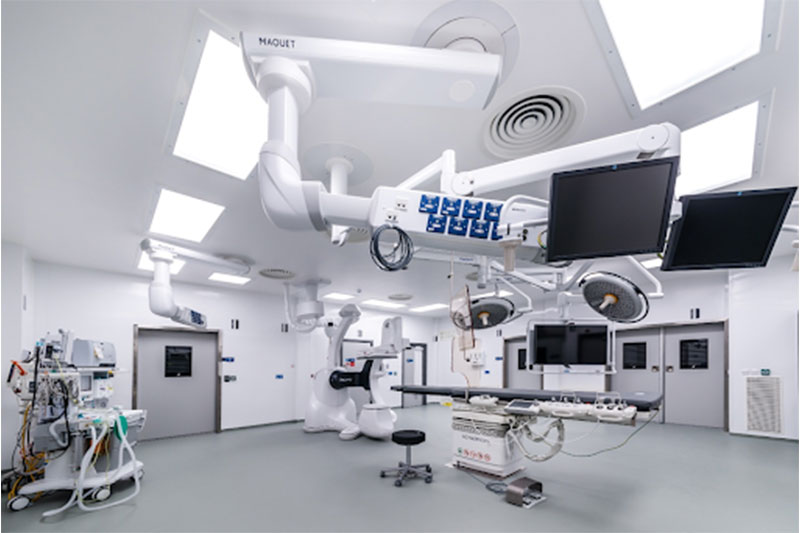
Operating theatres, intensive care units (ICUs), isolation suites, sterile services departments, pharmaceutical cleanrooms and diagnostic imaging departments demand doors that perform far beyond their basic function of providing access. They must actively contribute to infection prevention, withstand intensive cleaning regimes, resist physical damage, maintain dimensional stability, integrate with sophisticated environmental and access control systems and provide reliable performance over decades of continuous use.
Historically, PVC post-formed timber encapsulated doors have been specified extensively across many areas of healthcare because they offered an economical solution with an attractive appearance. They are marketed as hygienic because they feature smooth, easy-to-clean surfaces. Whilst this may be true when new, the long-term performance of the doorset is what matters in environments subjected to constant use and rigorous cleaning. However, advances in materials engineering and increasingly stringent infection prevention requirements have exposed inherent limitations in timber-based door construction, particularly within hygiene-critical environments.
Hygienic Glass Reinforced Plastic (GRP) door systems have been developed specifically to overcome these limitations. Unlike conventional laminate doors, which rely upon timber or wood-composite cores protected by decorative laminate surfaces, hygienic GRP doors are manufactured using moulded, fully encapsulated GRP construction. The result is a seamless, waterproof, non-porous and exceptionally durable doorset designed for the realities of modern healthcare and is why GRP has become the preferred specification for critical healthcare environments.
The eolution of healthcare door design
Hospitals have changed dramatically over the past three decades. The emergence of antibiotic-resistant organisms, increasing emphasis on infection prevention and control (IPC), higher patient throughput and more demanding cleaning protocols have fundamentally altered expectations of building materials. As a result, doors are now recognised as high-touch surfaces that contribute directly to:
- Environmental cleanliness
- Infection prevention
- Air pressure management
- Clinical workflow
- Patient safety
- Operational resilience
Modern operating departments may experience several thousand door cycles each week. Every movement of a trolley, bed or equipment cart creates opportunities for impact damage, contamination and wear. This operational reality requires doors specifically engineered for high hygiene and healthcare rather than adapted from commercial construction.
Understanding the difference in construction
The distinction between PVC post-formed timber encapsulated doors and hygienic GRP doors begins at their core. PVC post-formed doors rely on a PVC skin bonded around a timber-based core. Although durable in many healthcare environments, the PVC surface can become damaged following repeated impacts from beds, trolleys or equipment.
A conventional healthcare laminate door generally consists of:
- Timber or chipboard core
- Hardwood lippings
- High-pressure laminate (HPL) facings
- Adhesive bonding between materials
- Mechanical joints around glazing and hardware
Although visually attractive, this construction relies upon multiple interfaces between different materials. Every bonded joint represents a potential point of weakness over time. Moisture, repeated cleaning, impact damage and age gradually compromise these interfaces
Once the protective surface is breached, several issues can arise:
- Exposed substrates become significantly more difficult to clean effectively.
- Surface damage creates areas capable of trapping dirt, moisture and biological contamination.
- Repairs often involve patching rather than restoring the original seamless finish.
- Localised damage may require replacement of the entire door leaf to maintain hygiene standards.
In hygiene-critical environments, maintaining an intact, non-porous surface is essential, not only for appearance but for effective infection prevention.
GRP Is engineered for healthcare
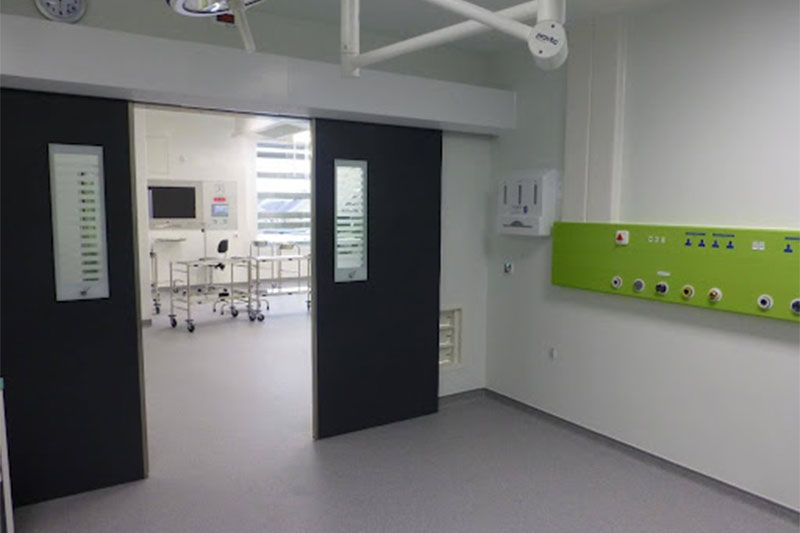
Unlike wrapped PVC constructions, hygienic GRP doors are manufactured using moulded Glass Reinforced Polyester technology to create an exceptionally robust, seamless construction. The result is a door specifically engineered for demanding healthcare environments where durability and hygiene are inseparable. Hygienic timber-free GRP Doors use an entirely different engineering philosophy. The structural skin forms an integral part of the door itself. The result is a true monolithic construction that provides:
- A seamless, non-porous surface that resists bacterial harbourage (even if the door is fire-rated).
- No exposed timber
- No laminate edges, wrapped corners or bonded surface joints that may deteriorate over time.
- Excellent resistance to impact from beds, trolleys and medical equipment.
- High resistance to moisture and washdown environments.
- Resistance to many aggressive hospital cleaning chemicals and disinfectants.
- Minimal maintenance requirements throughout the product's life.
- High structural rigidity and long-term dimensional stability
So, rather than protecting vulnerable timber, the entire door is engineered to resist healthcare conditions.
Infection prevention starts with surface integrity
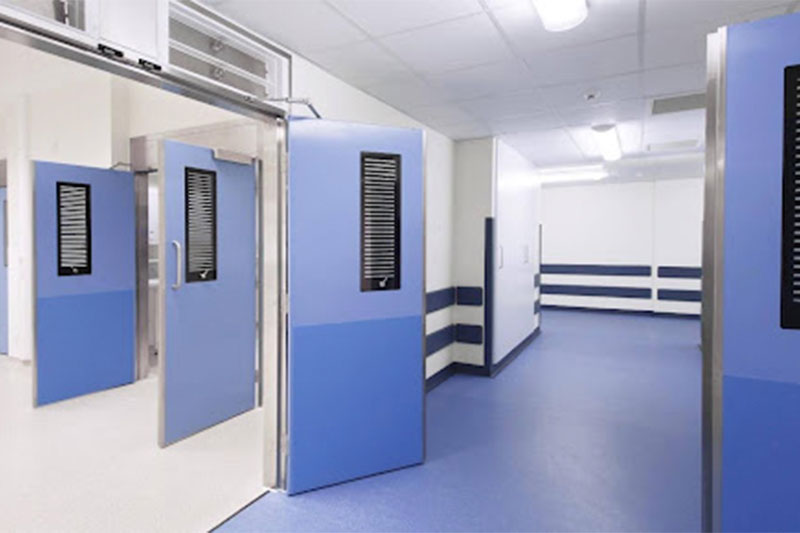
Environmental hygiene remains one of the most important factors in preventing healthcare-associated infections (HCAIs). Cleaning teams can only disinfect surfaces effectively if those surfaces remain intact. This is where GRP offers significant advantages. Unlike laminate doors, moulded GRP provides continuous surfaces which will never lift or delaminate.
The absence of exposed joints reduces areas capable of harbouring:
- Organic debris
- Moisture
- Microorganisms
- Cleaning residue
As a result, the smooth, continuous surface of hygienic GRP is inherently easier to clean and inspect. It is a non-porous material and does not absorb water. It cannot swell or soften following repeated washing. Its closed surface discourages microbial retention while allowing disinfectants to perform as intended. Timber products, by contrast, depend upon maintaining an intact decorative barrier. Once compromised, moisture may penetrate the substrate.
No timber means no moisture sbsorption
One of the principal differences between GRP and conventional post-formed construction is the absence of exposed timber or timber-based substrates. Should severe impact damage occur to a conventional wrapped doorset, the underlying core may become vulnerable to moisture ingress, swelling or degradation.
Hygienic GRP doors are manufactured using inert composite materials specifically selected for environments where repeated cleaning and moisture exposure are routine. This makes them particularly well suited to:
- Operating theatres
- Cleanrooms
- Pharmaceutical manufacturing
- Sterile Services Departments (SSD)
- Isolation suites
- Laboratories
Built to withstand intensive cleaning
Hospital cleaning protocols continue to become more demanding. Operating theatres undergo frequent cleaning using disinfectants designed to eliminate bacteria, viruses and spores. These cleaning regimes can include chlorine-based products, hydrogen peroxide vapour (VHP) decontamination and other powerful chemicals.
Hygienic GRP doors are designed for these environments, maintaining their surface integrity under repeated cleaning without requiring additional coatings or specialist maintenance.
Long-term performance matters
Initial purchase cost represents only a fraction of a doorset's lifetime cost. In a busy operating theatre, replacement carries significant hidden costs:
- Theatre downtime
- Clinical disruption
- Infection control measures during replacement works
- Labour and installation costs
- Waste disposal
For this reason, many healthcare estates teams increasingly assess doors based on whole-life value rather than initial capital expenditure. A doorset that maintains its performance for decades while requiring minimal maintenance can provide substantial operational savings.
Chemical resistance
Hospital cleaning chemicals continue evolving. Products designed to eliminate increasingly resistant organisms inevitably place greater demands upon construction materials. Hygienic GRP demonstrates excellent resistance to commonly used disinfectants. Repeated cleaning does not soften the material nor compromise bonded decorative surfaces, because none exist.
Fire performance
Healthcare doors rarely perform a single function.
Many require combinations of:
- Fire resistance
- Smoke containment
- Acoustic insulation
- Radiation shielding
- Hermetic sealing
- Access control
- Vision panels
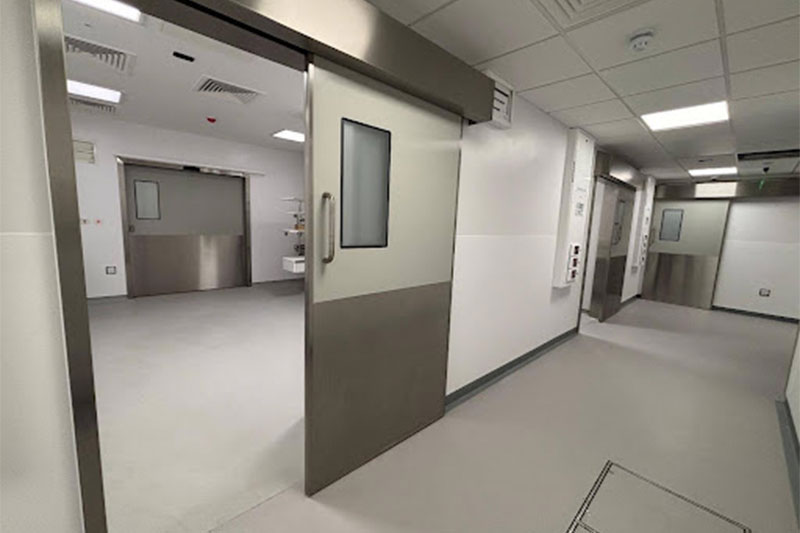
Hygienic GRP doorsets are independently tested to meet demanding fire standards while integrating these additional performance requirements into a single engineered solution. Up to 4 hours fire protection can be achieved with hinged doorsets, and up to 2 hours with sliding doors. And all tested in a variety of common wall construction types, including block, drywall and also cleanroom panels systems.
Where should hygienic GRP doors be installed in healthcare facilities?
Operating Theatres and Procedure Rooms
Operating theatres represent perhaps the most demanding healthcare environment
Theatres require doors capable of supporting:
- Positive pressure ventilation
- Laminar airflow systems
- Infection prevention
- Intensive cleaning
- Frequent traffic
- Equipment movement
Hygienic GRP aligns naturally with these requirements. Its smooth moulded finish withstands repeated disinfection while maintaining an excellent appearance.
Intensive care units and isolation rooms
ICUs combine intensive patient care with continuous cleaning. Door systems experience almost constant use. Unlike other products, GRP remains unaffected by continual washing and frequent impacts. The waterproof construction prevents gradual degradation that may otherwise occur over years of intensive service.
Sterile services departments
Sterile Services Departments operate under rigorous hygiene protocols. Equipment and sterilisation trolleys continually pass through door openings.
GRP offers outstanding resistance to:
- Physical impact
- Steam
- Humidity
- Cleaning chemicals
Its durability significantly reduces maintenance interruptions.
X-Ray and diagnostic imaging
Imaging departments require specialist doors capable of incorporating radiation shielding.
Hygienic GRP doors readily accommodate lead lining and laser protection, without sacrificing hygienic performance. This enables hospitals to maintain consistent aesthetics throughout imaging suites while delivering radiation protection and superior durability.
Specification should look beyond compliance
Compliance with fire testing, acoustic performance and accessibility standards is essential. However, these requirements should represent the baseline, not the specification's defining feature.
When selecting doors for hygiene-critical healthcare environments, specifiers should also consider:
- Long-term surface integrity.
- Resistance to impact damage.
- Fire performance
- Chemical resistance.
- Moisture resistance.
- Whole-life maintenance costs.
- Availability of integrated hygienic hardware and flush glazing systems.
- Proven performance in operating theatres, pharmaceutical facilities and cleanrooms.
Timber-free hygienic GRP systems address these competing requirements simultaneously, reducing the need for compromise between hygiene, durability, aesthetics and compliance. Rather than specifying a product based solely on appearance or capital cost, specifiers can select a solution engineered specifically for the realities of healthcare.
Conclusion
Operating theatres are among the most demanding environments in healthcare, where every component must withstand continuous use, rigorous cleaning and strict infection prevention requirements. While PVC post-formed timber laminate doors remain suitable for many general healthcare areas, hygiene-critical spaces require materials designed for far greater long-term performance.
Timber-free GRP doors are engineered specifically for these environments. Their seamless, non-porous construction resists moisture, chemicals and impact without relying on protective laminates or timber cores that can deteriorate over time. This helps maintain surface integrity, cleanability and durability throughout decades of service.
As healthcare increasingly focuses on whole-life value rather than initial cost, resilient materials that reduce maintenance, extend service life and minimise disruption are becoming essential. For operating theatres and other hygiene-critical areas, specifying timber-free GRP doors is not simply about meeting today's standards—it is about delivering reliable performance for the lifetime of the facility.