

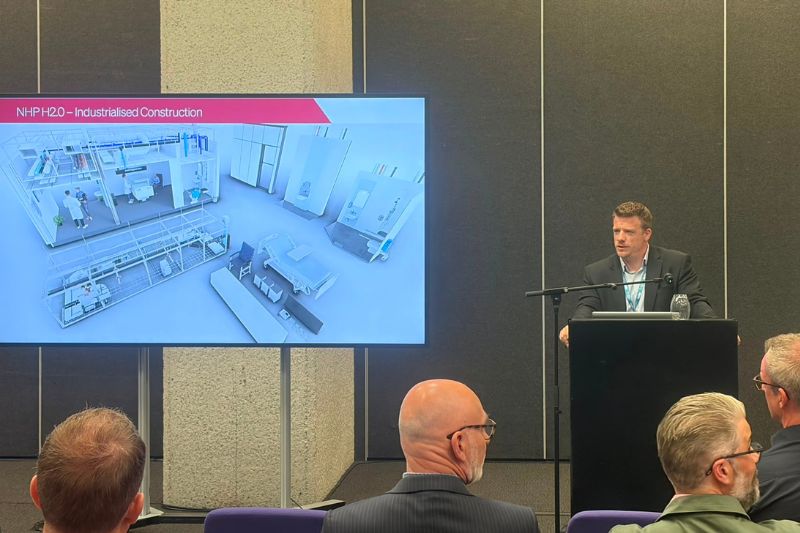
The New Hospital Programme (NHP) is currently preparing to roll out its standardised modular in-patient bedroom.
Off-site construction specialist, Reds10, is working with the NHP to develop the full-scale prototype of a standardised patient bedroom, en suite and adjoining corridor using modern methods of construction (MMC).
As part of this endeavour, Reds10 believes the initiative will accelerate the adoption of digital technology across NHS estates.
Speaking to Building Better Healthcare, Richard Fox, Director at Reds10, said the industry is moving beyond discussing AI, automation and smart sensors to embedding them into the design, construction and operation of future hospitals.
Fox believes that the Hospital 2.0 programme will pave the way for digital twins, smart sensors and AI-driven quality assurance to become integral to both the delivery and long-term management of NHS hospitals.
"I think what we're going to see in the industry is [a move] from concept and talking about how sensors, AI and automation can help, into it actually being done. That's certainly been our experience at Reds10, where it’s been part of day-to-day delivery for some time now," he said.
A step back into healthcare
While Reds10 has previously delivered healthcare projects, the company stepped away from the sector because it found delivery too fragmented and bespoke to support its industrialised construction model, which uses standardised designs, off-site manufacturing and assembly.
The New Hospital Programme changed that.
The New Hospital Programme has a dedicated focus on industrialised construction, said Fox.
"There is now a significant programme pipeline, a drive for standardisation and a commitment to industrialised construction. We thought, 'Well, it's time.'"
Rather than entering the market immediately, Reds10 followed its established product development process by designing, testing and certifying healthcare solutions before bringing them to market.
Working with the NHP, the company developed prototype patient rooms using Design for Manufacture and Assembly (DfMA), refining the designs through repeated clinical testing.
"There were so many decisions that needed to be made that we built the room and the module several times to inform the right decision," he said.
Rather than optimising purely for manufacturing efficiency, Reds10 worked with the NHP team and wider clinicians to balance buildability with patient care and staff wellbeing.
"There were a lot of commercial or construction decisions that, on the face of it, seemed like a better answer.
"But working with the clinical team and seeing the testing they were doing to reach the right decisions, that was eye-opening."
The use of digital twins, sensors and AI
Reds10 believes one of the biggest opportunities created by Hospital 2.0 lies beyond construction itself.
The company has spent many years embedding smart sensors into buildings, collecting operational data to improve building performance and inform future designs.
Within hospitals, however, Fox said the potential is significantly greater.
The amount of data to collect in a live operational hospital environment is significantly greater than most other sectors, Fox said.
This data can be extremely useful however.
Rather than handing over a completed building and stepping away, Reds10 envisions future hospitals becoming living digital assets, with digital twins continuously monitoring how facilities perform throughout their operational life.
"It is all too often in the world of construction that once you've built something and handed the keys over, it gets forgotten," said Fox.
"There are learnings, maintenance and best use of the buildings."
Fox said each modular hospital solution contains tens of thousands of individual components, making AI increasingly important for managing the complexity of design, manufacturing and delivery.
Reds10's vertically integrated business, which brings together 12 specialist companies spanning steel fabrication, fit-out, land development, furniture and other disciplines, enables the company to coordinate that complexity through a single delivery model. Harnessing the learnings and data into a vertically integrated approach.
The data generated by smart sensors can monitor how people move through hospital spaces, identify maintenance requirements and provide insights to improve future hospital designs.
For facilities management teams, the goal is to make that information easily accessible through AI.
"You should be able to speak to the building and ask, 'Where are the problems? Where is the maintenance schedule? How many people do I need? Create me a plan.' Simplifying that world is going to be key."
Fox compared the industry's shift towards digital twins with the adoption of Building Information Modelling (BIM).
"It was no different to having 2D CAD software into the world of actually using BIM and structuring data. There was a big shift in how that world changed, and this is an even bigger shift."
More Hospital 2.0 models?
Although Reds10's work has focused on repeatable patient bedrooms for the Hospital 2.0 model, Fox confirmed the company has also designed and tested other H2.0 repeatable clinical spaces.
Lessons from the prototype programme have been fed back to the NHP, which will determine how the designs are incorporated into future Hospital 2.0 projects.
"We've constantly fed back all the learnings. That's now with the New Hospital Programme team."
What is ahead for Reds10?
With Hospital 2.0 expected to shape the next generation of NHS hospitals, Reds10 believes success will depend on collaboration across the construction sector.
The company intends to work with the programme's appointed principal contractors while sharing lessons with other industrialised construction providers.
It will take more than just us to deliver these hospitals.
"The visibility of the pipeline will allow the industrialised construction community, whether that's bathroom pods, panelised systems or volumetric construction, to re-enter the market and invest."
Fox said the programme's clear pipeline, standardisation and commitment to industrialised construction are among its greatest strengths.
For organisations beginning their own digital transformation, however, he believes the biggest challenge comes before AI itself.
The biggest challenge for AI and automation is organising and cleansing data.
"Every business has enormous amounts of data. Once you've organised it and put it in your data factory, efficiency completely takes over."
As Hospital 2.0 moves from prototype to delivery, Fox expects digital twins, AI and industrialised construction to become embedded across NHS hospital projects.
"In time," he said, "this will become the norm."