

The New Hospital Programme (NHP) has entered a new phase of delivery after completing a new collaborative procurement process designed to bring together NHS trusts and construction partners under a single alliance model.
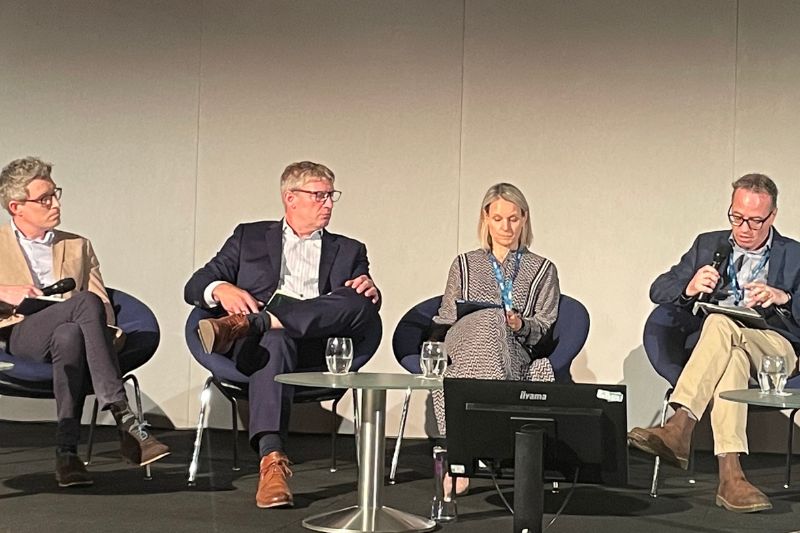
Speaking at the European Healthcare Design Congress, Emma Whigham, who serves as the NHP Alliance Director, said the programme had moved away from a traditional competitive procurement approach to create a structure where trusts and contractors could work collectively.
“The alliance for us is probably, to use my own words, our superpower in terms of 11 trusts, 10 contractors, all of the different organisations and experience in NHP,” she said. “It’s how we harness that to deliver the programme.”
The panel discussion brought together two leads from the New Hospital Programme, a healthcare director from Laing O’Rourke, and a strategic director from the Norfolk and Waveney University Hospital Group, to discuss how the programme has evolved following delays and changes to its delivery model.
The NHP was first announced in 2020, but funding for the first wave of hospitals was only confirmed in 2025.
Eamonn Sullivan, National Clinical Director and Chief Nurse of the New Hospital Programme, said the programme reflected a need to address long-term underinvestment in NHS estates.
The estate of the NHS is in emergency, we are ambitious, and there is a real imperative for change, he said.
Collaborative allocation replaces traditional competition
A key change has been the introduction of “collaborative allocation”, where 10 contractors were brought into the alliance and matched with 11 hospital schemes through a process described by Whigham as “speed dating”.
“Literally all of the contractors met all of the trusts,” she said. “They then worked through with their own teams in terms of, okay, which [hospitals] do we think we’ve got a good chance of being able to deliver.”
Whigham said the approach was designed to avoid a situation where some trusts secured stronger commercial positions than others.
“There are winners and losers, so some of those that are quicker out of the block, some of those that maybe have a contractor that is a bit more savvy might well get everything that they want, but that will be at the detriment of another trust,” she said.
“The programme and the alliance creates the opportunity for us to have 11 winners.”
The 11 contractors who won a spot on the Hospital 2.0 Alliance framework were appointed to Wave 1 hospitals within months of procurement finishing.
The programme aims to have all 11 schemes into contract by the end of July.
“We have onboarded those 10 contractors, we’ve introduced them to our Hospital 2.0 system,” Whigham said. “We’re already starting to share what’s working, what’s not working, how we’re learning.”
Removing competition changes Trust and contractor relationships
Keir Dawson, who serves as the Healthcare Lead at Laing O’Rourke, said the alliance model represented a different relationship between contractors and clients compared with previous approaches.
“We do feel like we’ve got a seat at the table with the client, the trust and the contractors,” said Dawson.
We are speaking to each other in ways we probably never spoke to each other before.
He said removing direct competition had changed how contractors worked together.
“Taking away that competitive bit has made the contractor speak to each other, surprise, surprise, because we’ve not all got to compete against each other,” he said.
Dawson also highlighted the importance of a sustainable supply chain, arguing that contractors needed to be able to operate profitably to continue investing in future projects.
“As a contractor, we need to make money to invest again, to employ the best people, to build the next hospitals,” he said. “We need to exist. We need to sustain it.”
Standardising design through Hospital 2.0
The panel also discussed Hospital 2.0, the NHP’s approach to standardising elements of hospital design while allowing flexibility for individual sites.
Sullivan said the approach was not simply about building layouts, but about changing how hospitals are designed and operated.
“The layout and the design aspect are one small part of the programme, it’s a much bigger thing about how to deliver this kind of scale and ambition,” he said.
The programme has created feedback mechanisms intended to capture learning across the alliance.
Whigham said the lessons from contractors and trusts would feed back into the wider system.
“As collaborative allocation was going on, that could have been wasted time, but what we did was at the same time set up that feedback loop and pass that back to our integration team and technical team,” she said.
The programme is also looking to expand participation beyond the initial alliance members, with professional services, designers and architects being considered as future participants.
We don’t see the alliance as it currently is to be where we ultimately end up, Whigham said.
“It needs to grow, and it needs to develop, and all of those major, significant parts of the supply chain that have real influence, real impact on the outcome, need to come be part of it.”
Concerns remain over pace, capacity and delivery
The session also reflected concerns from the healthcare design community about whether the programme can deliver its ambitions, given previous delays and the scale of the challenge.
In January, the NHP was restructured with updated funding, timetables and standardised designs, including delays for reinforced autoclaved aerated concrete (RAAC) hospitals.
A question from the audience challenged the panel on whether there was enough evidence that a centrally driven programme could reduce cost, improve quality and speed up delivery.
Sullivan acknowledged the frustration around the timeline.
“It was December 2020 when Boris Johnson announced 40 hospitals, and I was working at a wave three hospital that was literally falling down, and was flooding, and had electrical failure,” he said. “So, we share your frustration.”
He said the existing approach to hospital construction would not be enough to meet future demand.
“What we’ve done in the past, although it’s built fantastic hospitals, it’s not enough for what we’re facing and what our populations are facing in the future, so we have to do something different,” he said.
The panel also highlighted workforce and supply chain capacity as a major constraint.
Whigham said future funding models, including renewed discussions around private finance, were not ruled out but depended on addressing wider industry capacity issues.
“The biggest challenge that we’ve got right now is capacity,” she said. “There aren't enough trades, designers, and architects. The whole system at the moment is stressed because of the sheer amount of what we’re trying to do.”
Alliance enters the “hard yards”
While the panel highlighted progress, speakers repeatedly stressed that the alliance was still in its early stages.
“We’re in the honeymoon period,” Whigham said. “I’m not going to sit here and say it’s all perfect, it’s definitely not. We’re only really in its infancy. There’s a long way to go.”
Martin John, who serves as the Strategic Director of Norfolk and Waveney University Hospital Group, said the programme had reached a point where delivery was becoming tangible, but warned that the next stage would be critical.
“We are at that tipping point now. We have construction partners in place, it’s real,” he said. “It wasn’t quite real before.”
Dawson said industry partners were already looking at ways to accelerate delivery.
“We are looking at how we can go faster,” he said.
We don’t just want these hospitals, we need them.
The next stage for the NHP will be translating the alliance model from procurement into construction delivery, with speakers emphasising that in July the formal contracts for the 10 construction partners would be finalised.
“By the time that we get to the end of July this year, we're hoping to get all 11 into contract, and away we go on those individual trajectories,” said Whigham.


