

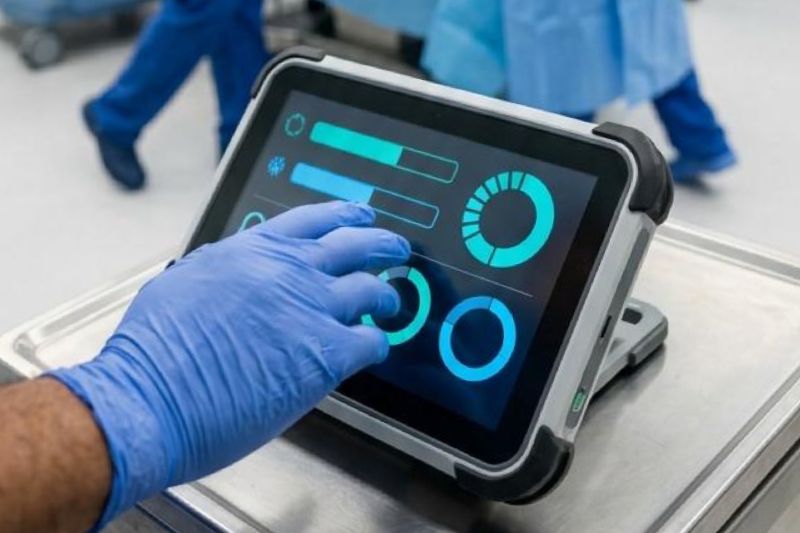
Proximie, AWS and Deloitte are working with eight NHS hospital sites on a year-long programme to assess whether AI can improve theatre efficiency and increase surgical capacity
Proximie has launched what it describes as the largest surgical AI evaluation undertaken in the NHS, with its technology being deployed across 104 operating theatres, endoscopy suites and catheterisation laboratories at eight NHS hospital sites.
The year-long programme, delivered in collaboration with AWS, Deloitte and participating NHS organisations, will assess whether AI-driven operational intelligence can help hospitals treat more patients using their existing theatre capacity and workforce.
Proximie’s Intelligence Suite captures surgical and operational data in the background without disrupting clinical teams. The data is de-identified at source before being analysed by AI models to identify bottlenecks and opportunities to improve theatre flow.
The programme is expected to cover more than 20,000 procedures a year, with participating sites using the insights to reduce delays between operations and make greater use of available theatre time.
AWS is providing the cloud and AI infrastructure for the programme, while Deloitte is supporting delivery and transformation across participating NHS trusts and the NHS London region.
Partnership designed to move beyond individual AI pilots
Victoria Hatcher, Chief Customer Officer at Proximie, told Building Better Healthcare programme had been developed to move beyond individual technology deployments and establish evidence for wider NHS adoption.
“We recognize the power of public and private partnerships when it comes to moving past one-off pilots to deliver systemic improvements that get embedded within the day-to-day running of NHS Trusts at a national scale,” said Hatcher.
The NHS London region endorsed the programme as a way of evaluating how scalable technology and AI could be adopted consistently across different NHS settings, rather than relying on results from a single hospital.
“They wanted to be considered and thoughtful about how scalable technology and AI get adopted, rather than proving something in one hospital and hoping the result travels,” said Hatcher.
The programme is therefore being evaluated across different sites under a single framework, with the aim of establishing whether the findings can be applied more widely across the NHS.
Each organisation has a defined role, with Proximie providing the technology, AWS supplying the cloud and AI infrastructure, Deloitte supporting change management, and NHS trusts contributing clinical and operational expertise.
Take any one of those out and the programme does not work, Hatcher said.
Eight NHS sites selected to test AI across different settings
The participating trusts were not selected solely by Proximie.
The proposition was presented to the London chief executives' meeting and the London Digital Transformation Board, after which trusts volunteered to take part.
“An evaluation of this size only works with complete buy-in, so self-selection was critical,” Hatcher said. “Buy-in of that kind cannot be mandated.”
The programme has subsequently been structured to include a broad range of hospital environments, including different hospital sizes, electronic patient record systems, room configurations and specialty mixes.
The participating facilities include operating theatres, endoscopy suites and catheterisation laboratories.
Hatcher said this variation was important to determining whether the technology could operate effectively under the different conditions found across NHS hospitals.
“We wanted to know whether the programme survives the realities of how operating rooms actually run, rather than whether it works in a perfect situation,” she said.
“Running it across that many sites and specialties is also the only way to see how large the variation is.”
The year-long evaluation will also allow learning from one site or specialty to be tested elsewhere during the programme, rather than waiting until its conclusion.
AI designed to operate without adding to theatre workload
Proximie said the introduction of the Intelligence Suite has been designed so that clinical teams do not have to undertake additional manual work.
“For the theatre team, nothing changed, and that was a design requirement rather than an aspiration,” Hatcher said.
“The test we set ourselves whenever we design a capability is that it has to be zero work, not just not much work. A system that asks a scrub nurse to press a button or fill in a field will not survive contact with a busy list.”
The system uses fixed sensors to capture data automatically, with Hatcher saying the sensors take one frame per second without requiring manual input from staff in the room.
Images are obscured and de-identified at source, with the AI models operating on de-identified data.
The work required to introduce the system has instead focused on information governance, electronic patient record integration and site surveys before sensors are installed.
Deloitte to embed AI insights into theatre management
Deloitte will work with operational teams, theatre managers and clinicians to incorporate the data generated by Proximie into existing theatre processes.
This includes surgical scheduling and operational huddles during the day, with the aim of improving the use of theatre lists and reducing turnaround times between cases.
“We’ll be working with key Trust stakeholders including operational teams, theatre managers, and clinicians, to embed the data and associated insights into the current theatre processes,” Edward Sturgess, Associate Director in Deloitte’s UK Health Practice, told Building Better Healthcare.
“This includes business as usual surgical scheduling processes to help increase booking of theatre lists, as well as operational huddles in theatres through the day to improve turnarounds between cases.”
Proximie said earlier deployments of the Intelligence Suite had indicated the potential to enable an additional surgical case per day through improved theatre flow and operational efficiency.
The technology is already deployed across NHS organisations including University Hospitals Coventry and Warwickshire and Barking, Havering and Redbridge University Hospitals NHS Trust, where Proximie reports an 8.2% increase in cases and a 30% reduction in turnover time.
Hatcher said the results were driven not by setting higher utilisation targets, but by giving operational teams better information about what is happening inside theatres.
Targets do not create capacity. Experienced people acting on information they trust does, said Hatcher.
“Every Trust has the same 85% utilisation target, and how you get there differs completely between sites, between specialties and even between teams.”
Programme will examine where theatre time is being lost
According to Proximie, analysis from previous deployments has identified discrepancies between manually recorded theatre data and what actually happened during procedures.
Hatcher cited a dataset of 3,341 matched cases in which manually entered records overstated case duration in 59% of cases.
She also said analysis had identified the impact of over-booking on theatre utilisation, with early finishes releasing significantly more booked theatre time than was lost through overrunning in one tracked week.
“Lists that look full on paper are the leak, and most of the management conversation is pointed at the smaller half of the problem,” Hatcher said.
The intention is for clinical and operational teams to use the data to change how theatres are managed, rather than Proximie prescribing a single operational model.
“Once teams can see both, the changes are theirs rather than ours,” Hatcher said.
“Turnaround comes down because cleaning, scrub and anaesthetic teams coordinate differently when everyone can see the state of the room, not because anyone has been asked to work faster.”
Deloitte's role will include embedding these changes into day-to-day workflows and supporting trusts with the organisational change required to act on the information.
Eight-site evaluation will establish baseline performance
Deloitte will establish baseline performance before the programme goes live across a series of theatre key performance indicators.
These will include cases per list, turnaround times, unutilised theatre minutes and cancellations, with the measures tracked throughout the implementation period.
Sturgess said: “These will then be tracked through the implementation period to understand impact and identify the key drivers and interventions.”
Deloitte will also establish governance processes to continue monitoring performance after the programme has been completed.
This will help assess whether any improvements can be sustained and identify which interventions could potentially be adopted more widely across the NHS.
Programme to measure recoverable theatre capacity
The central question for Proximie will be whether hospitals can treat more patients using the theatres, staff and hours they already have.
“The headline measure is simple to state. Can we treat more patients using the theatres, the staff and the hours the NHS already has?” Hatcher said.
“Not by building more theatres, not by adding lists, and not by asking people to stay later. That is what we expect to be judged on.”
The programme will track first-case on-time starts, turnaround times between cases, list utilisation and the amount of theatre time that can be recovered.
Proximie said existing deployments have identified 19% to 25% recoverable theatre time across sites in the UK, Africa, the Middle East and North America.
Hatcher said establishing where that lost capacity comes from is a prerequisite to improving theatre efficiency.
Nobody can fix what they cannot see, said Hatcher.
The programme will also assess the financial impact of any operational improvements, including whether the technology can reduce per-procedure running costs and contribute to shorter waiting lists.
“For the technology to be adopted more widely it has to reduce per procedure running costs for the NHS and reduce waiting list times,” Hatcher said.
The findings from the year-long evaluation are expected to provide evidence on whether AI-enabled theatre intelligence can be scaled across different NHS settings and translated into measurable improvements in surgical capacity.


