
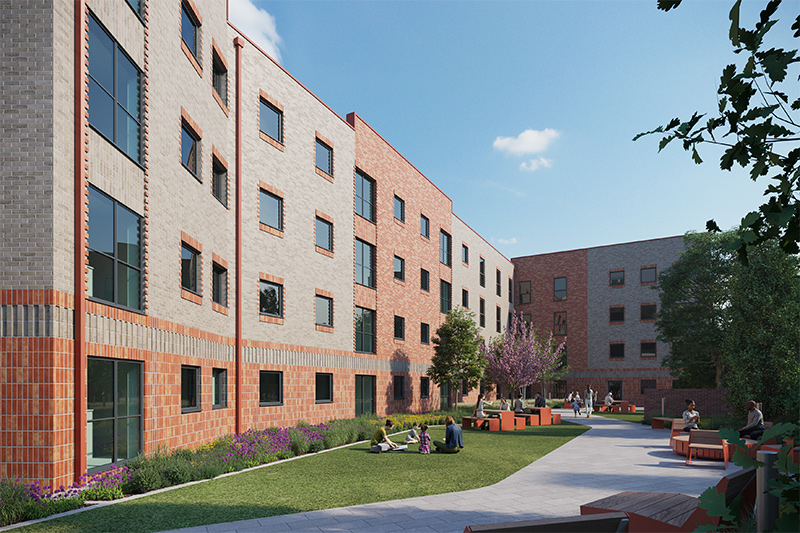
Solving this challenge requires more than isolated developments or short-term fixes. It demands new ways of working, long-term commitment and genuine collaboration across the supply chain, writes Sion Owen, UK HQ Branch Manager, at GOLDBECK; one of Europe’s leading suppliers of systematised building solutions.
A recent analysis by Shelter, the housing charity, found that private rentals are now largely unaffordable for newly qualified nurses in 45% of English local authorities and equally unaffordable for other key workers in a large share of the country, with London and the South East worst affected.
Additional research by the NHS Homes Alliance has also shown that only around 8% of UK towns have homes affordable for key public sector workers, including nurses, teachers and emergency services, based on house price to earnings ratios, demonstrating how far housing costs have outpaced key worker incomes.
Further independent analyses by the Office of National Statistics indicates that renting a one bed property is unaffordable for newly qualified nurses in roughly half of English local authorities, a common affordability threshold. This is supported by a Savills report that highlights the lack of affordable, quality housing in appropriate locations, as a key factor in recruitment and retention challenges, which show that this could influence key workers’ decisions to leave roles.
Together, these statistics illustrate that key workers, especially in health, education and emergency services, face substantial barriers to living in the communities where they work, lending weight to the need for purpose built, affordable housing solutions like Oak House.
This is the context in which GOLDBECK and Prime plc are working together to deliver a new generation of key worker accommodation. While Oak House in Poundbury Road in Dorchester is an important milestone, it also represents something much bigger – a scalable approach to affordable housing delivery that prioritises quality, speed and long-term value.
From one project to an ongoing programme
Oak House will deliver 79 key worker homes for staff at a neighbouring hospital, providing a mix of studio, one, two and three-bedroom apartments. The development is due for completion in early 2027 and will be delivered using a design and build model.
For both partners, the project is not viewed as a standalone intervention. Instead, it forms part of a broader programme-led response to a national issue. Prime plc has a long-standing focus on delivering key worker housing that supports essential workers, recognising that access to secure, affordable homes is fundamental to workforce retention and community resilience.
Prime’s keyworker housing developments are operated by not-for-profit property management company Hyve by Prime.
For GOLDBECK, Oak House marks the launch of its UK residential offering. Having delivered residential schemes successfully across Germany and other countries, the company has spent the past two years adapting its systemised construction approach to meet UK regulatory, cultural and market requirements.
Systemised construction ensures that construction elements, processes and procedures are standardised. The aim is to reduce complexity and ensure quality. In short, GOLDBECK’s process systemises the invisible and individualises the visible, based on industrially manufactured system elements, which they assemble into an individual building. The Dorchester scheme provides a vital opportunity to demonstrate that this proven model can be applied effectively in the British context.
One of the defining features of the project is the strength of the partnership between developer and contractor. Prime selected GOLDBECK, not simply as a delivery partner, but as a collaborator able to offer a different solution to the residential market.
This open-mindedness has been critical. Systemised construction requires early engagement, trust and alignment on outcomes. By working together from the design development stages, both parties were able to integrate GOLDBECK’s approach with minimal disruption to the original planning intent. The result is a scheme that meets local expectations while benefiting from a more efficient delivery model.
This kind of partnership is increasingly important in affordable housing, where tight margins and rising costs leave little room for inefficiency. By sharing knowledge and ambition, developers and contractors can unlock solutions that would be difficult to achieve in isolation.
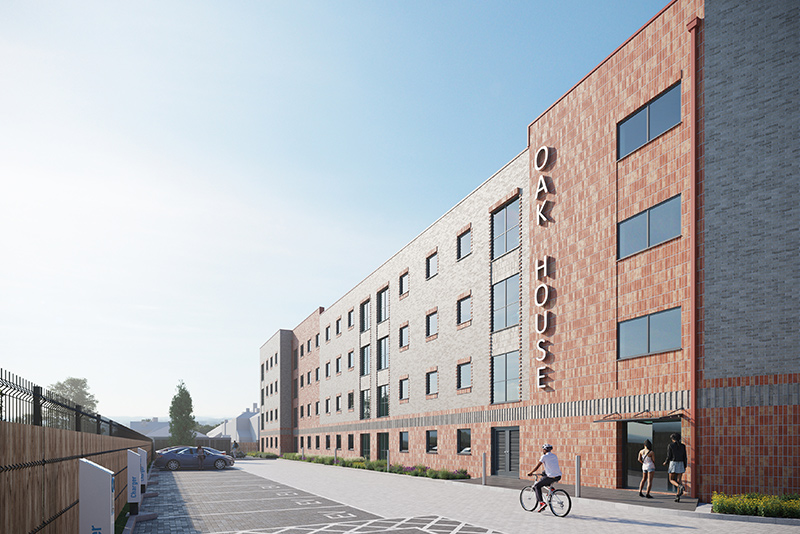
Speed, certainty and quality
This is because one of the most pressing challenges facing the housing sector is delivery speed. Traditional residential construction is often slowed by long design and procurement processes, labour shortages, weather disruption and complex sequencing. For schemes serving key workers, delays have real human consequences, prolonging pressure on local services and staff.
At Oak House, GOLDBECK’s systemised approach is expected to reduce the overall build programme by up to 25 per cent.
Crucially, speed is not achieved at the expense of quality. Tighter production tolerances and controlled manufacturing environments result in consistent finishes and robust performance. For residents, this translates into homes that are comfortable, durable and designed to meet modern expectations.
This is happening against a background where key worker housing is no longer a niche issue. NHS trusts across the country report recruitment and retention challenges linked directly to housing affordability. In many areas, staff are forced to commute long distances or rely on insecure private rentals, increasing stress and reducing workforce stability.
Developments like Oak House offer a practical response. By providing purpose-built accommodation close to places of work, they reduce travel time, improve quality of life and help employers retain skilled staff. For communities, this means more stable public services and stronger local economies.
Importantly, this type of housing also represents good long-term value. Well-designed, robust homes with predictable maintenance profiles are attractive assets for operators and investors alike, supporting the case for repeat delivery rather than one-off schemes.
For Prime, the project reinforces a long-term commitment to addressing housing need through innovation and collaboration. Rather than relying solely on traditional construction models, Prime is actively exploring new ways to increase certainty and improve outcomes in a challenging market.
In short, the UK’s housing challenges require aligned partnerships, early engagement and a willingness to rethink how homes are delivered. The collaboration between GOLDBECK and Prime demonstrates how these principles can be applied in practice.
Oak House is one building, on one site, in one town. But the ideas behind it such as partnership, programme-led delivery and a focus on those who keep society running, have national relevance. As pressure on housing continues to grow, models like this will become increasingly important.
Affordable housing for key workers is not a short-term trend. It is a structural requirement for a functioning society. By working together and investing in better ways of building, GOLDBECK and Prime are helping to lay foundations not just for new homes, but for a more resilient housing system.
Image credit: GOLDBECK


