

Healthcare environmental hygiene encompasses everything from surfaces and equipment to air, water and the design of a hospital itself, all of which can affect how effectively pathogens are controlled.
Dr Alexandra Peters, President of the Clean Hospitals coalition and a researcher at the University of Geneva’s Institute of Global Health, tells Building Better Healthcare that more research is needed to understand which approaches to environmental and hand hygiene are most effective in healthcare settings, and how that evidence can be translated into practice.
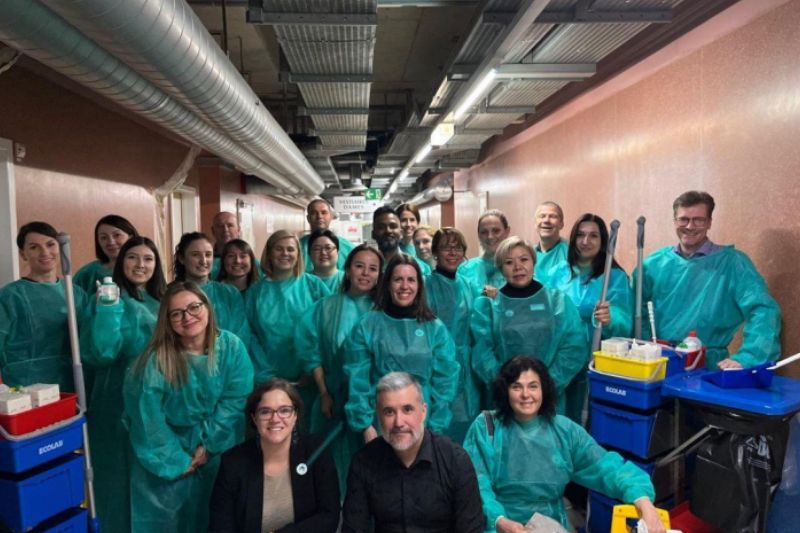
Established in 2018, Clean Hospitals is an initiative that brings together academic, clinical and industry expertise through research, education, conferences, networking and specialist working groups.
Its network spans countries across Europe, Asia, the Middle East and the Americas, with country leads providing regional perspectives on healthcare hygiene.
Over the past seven years, the network has published almost 65 peer-reviewed papers on healthcare environmental hygiene and hand hygiene, conducted research studies, organised conferences and collaborated regularly with international infection prevention groups and ministries of health.
It has also established Clean Hospitals Day, an international initiative intended to raise awareness of the importance of healthcare environmental hygiene.
This year's Clean Hospitals Day will take place on 20 October, and the theme is “Empowerment”.
Clean Hospitals has developed a toolkit of posters and other campaign materials to promote staff empowerment in healthcare environmental hygiene and raise awareness of its role in preventing infections.
The network currently also has a number active working groups addressing specific issues in environmental and hand hygiene, and hosts monthly lectures or “ThinkTanks”, given by top international experts on an array of diverse topics such as controlling pathogens such as (C. difficile),a . C.auris, to genomic surveillance, hand hygiene, antimicrobial resistance and biofilm control.
Peters has been involved with Clean Hospitals since its establishment, initially leading its scientific research, and took over its leadership in 2025.
For Peters, the challenge now is translating the growing body of research and expertise into practical improvements in hospitals.
That includes looking at the physical environment in which healthcare is delivered, the products used, the training and monitoring and integration of the workforce, and how hospital design can either support or hinder effective cleaning.
“Hospital design and the built environment is definitely something that we're aware of, and that has a huge impact on how easy a hospital is to keep clean, or if it's even possible,” she said.
Applying research findings to hospital design
Peters said hospital design can create problems that are difficult to address once a facility is operational.
Older hospitals, she said, were often designed around factors such as patient movement and operational efficiency, with infection prevention not always considered to the same extent.
New-build projects therefore provide an opportunity to address potential problems earlier.
“There are so many things that can be done so that they won't be an issue further down the line,” Peters said.
One example is the clinical sink.
Peters said sink splash and drainage can present infection-control concerns as they can become reservoirs for multidrug-resistant organisms.
“So much so that they're pulling sinks out of many ICUs at the moment because they've just been reservoirs for multi-drug resistant organisms,” she said.
But you can't pull out every sink, right? So it's a little bit complex.
Peters said a range of technologies are now being tested to address the problem, including devices designed to disinfect sinks using methods such as steam, bleach and peroxide.
“There are all kinds of new devices on the market that are supposed to help disinfect sinks,” she said.
She said sink design itself could also help prevent the problem, pointing to splash as an example of an issue that could potentially be addressed at the design stage.
“That's something that could be 70% better with a better sink design,” she said.
“I've been in hotels where you put the water on full blast, and there is not a droplet flying out of that sink,” she said. “It's been designed not to splash because the bathroom is tiny and they don't want water everywhere. We can't figure it out in a hospital?”
The same issue can arise with materials.
Peters said flooring needs to balance durability, chemical resistance and slip resistance with its ability to be cleaned.
She cited faux wood-grain flooring as an example of a design choice intended to make healthcare environments less institutional but which can introduce additional cleaning challenges.
“We're unfortunately not always improving,” she said.
She also recalled visiting a state-of the art university hospital where soft furnishings and felt materials had been used in a private ward despite being difficult to clean effectively; much to the chagrin of the infection control team.
The infection prevention and control team doesn't always talk to the people making the purchasing decisions, even though they should, said Peters.
The people behind the data
Clean Hospitals' work also extends beyond the physical hospital.
Technology is increasingly being used to monitor cleaning, including systems that can track cleaning routes and the time spent in rooms.
Peters said such technology can be useful, but only if hospitals are clear about what they are trying to measure.
“I think it's important to know what you want to monitor and to make sure that you monitor in a way that encourages people and doesn't make them feel like they're being policed,” she said.
Hospitals already use methods including visual inspection, fluorescent markers, adenosine triphosphate (ATP) testing and microbiological assessment, although each measures different aspects of cleaning performance.
For Peters, however, there is a danger of focusing on increasingly sophisticated monitoring while overlooking the conditions in which cleaning staff are expected to work.
“If you gave your EVS staff more than seven minutes to clean the room, maybe they could also do a better job,” she said.
She argues that hospitals need to focus on the people actually carrying out the work, alongside the data used to assess it.
Data, we can have it, she said. But…you have to focus on the person that's actually doing the cleaning.
A case for investment
For Peters, that comes back to how healthcare facilities value environmental hygiene.
Rather than treating cleaning, hand hygiene and infection prevention simply as costs, she believes hospitals need to consider their wider value.
“I think hospitals need to stop focusing on cost and start focusing on value,” she said.
She argues that investment in environmental hygiene, hand hygiene and infection prevention should be considered against the clinical and financial consequences of healthcare-associated infections.
“Environmental hygiene and hand hygiene and infection prevention and control is always worth investing in,” she said.
That philosophy sits behind Clean Hospitals' wider work to bring together research, healthcare and industry expertise.
For NHS trusts, it also raises questions that extend beyond the infection-control department.
Peters says the questions that trusts should be asking should be things like:
-
Are hospitals giving cleaning staff enough time to do their jobs?
-
Are monitoring technologies measuring the right things?
-
Are infection prevention teams involved when materials and equipment are selected?
-
And are new hospitals being designed with effective cleaning in mind from the outset?
Peters' argument is that environmental hygiene cannot be separated from the wider environment. “We're humans,” she said. “Everything's interconnected.
"We need to be responsible about the products we use and the effect that they have on ecosystems, the resistance that they can create in bacteria. We need to be responsible concerning the waste that we produce in healthcare, and make decisions to move towards sustainability whenever possible without affecting overall patient safety.”
As Clean Hospitals continues to develop its research, working groups and international network, the challenge will be turning that growing evidence base into changes in everyday healthcare practice.
For the NHS, that could mean bringing environmental hygiene into conversations about hospital design and procurement much earlier, while also ensuring that the people ultimately responsible for keeping those hospitals clean have the time, training and resources to do so.
Because, for Peters, a clean hospital is not simply a building that is cleaned. It is an environment designed, operated and maintained with infection prevention in mind.


