

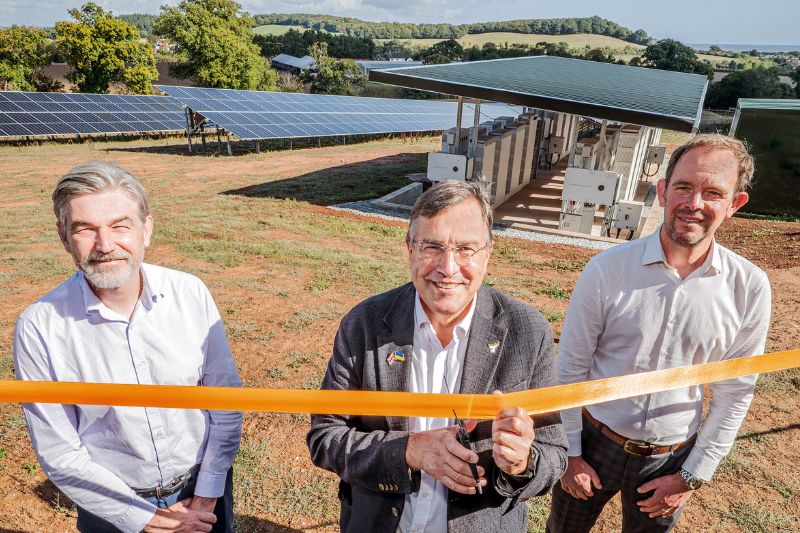
Langdon Hospital in Devon has switched on a 1.042 MW solar and battery storage system expected to meet more than 60% of the site’s annual electricity requirements.
The ground-mounted installation at the Dawlish hospital was designed and delivered by renewable energy specialist SunGift Solar, with funding provided through a national clean energy grant awarded to Devon Partnership NHS Trust by the Department for Energy Security, Net Zero and Great British Energy.
"This investment not only supports our commitment to sustainability but also ensures significant cost savings that can be redirected into enhancing patient care,” said
Phill Mantay, Chief Executive at Devon Partnership NHS Trust.
The system is forecast to generate more than 1.068 million kWh of electricity a year and reduce the Trust’s electricity costs by nearly £185,000 annually.
The system is also expected to cut carbon emissions by more than 145 tonnes a year.
The installation was officially switched on by Martin Wrigley, MP for Newton Abbot, and Phill Mantay, Chief Executive of Devon Partnership NHS Trust.
1,628-panel solar array
The solar park covers approximately 3.5 acres of land next to Langdon Hospital and comprises 1,628 JA Solar panels.
At the start of this year, JA Solar announced that its back-contact (BC) solar cells have achieved a certified conversion efficiency of 28.2%, establishing a new record for BC cell technology.
The panels are mounted on a low-carbon steel ground-mounting system supplied by Solarport, which SunGift Solar says has 66% lower embodied carbon than conventional mounting structures.
"Through the use of commercial solar cells, coupled with one of the largest battery storage installations of its kind in the UK, we have transformed a relatively small parcel of land into a hugely valuable solar asset capable of delivering the majority of the hospital’s annual electricity needs,” said Gabriel Wondrausch, Director at SunGift Solar.
The installation has a generation capacity of 1.042MWp and is designed to supply electricity directly to the hospital, reducing its reliance on power from the grid.
NHS England spends £1.4bn on energy, and this figure has doubled since 2019.
The project is also intended to improve resilience during periods of high electricity demand, including hot weather when demand for air conditioning increases.

Battery storage
The solar array is supported by Sigenergy hybrid inverters and SigenStack battery storage.
The batteries allow surplus electricity generated during the day to be stored and used when demand is higher or solar generation is lower.
This enables the hospital to increase its use of electricity generated on site and reduce its exposure to higher grid electricity prices during peak periods.
The system also has the potential to export surplus electricity to the grid, which could provide an additional source of income for the Trust.
The works were carried out while the hospital remained operational.
The project is expected to support Devon Partnership NHS Trust’s wider carbon reduction plans and its work towards the NHS net zero targets.


